Physicist have now provided the first major results of NASA's Magnetospheric Multiscale (MMS) mission, including an unprecedented look at the interaction between the magnetic fields of Earth and the Sun, The magnetic fields of Earth and the sun. The article describes the first direct and detailed observation of a phenomenon known as magnetic re-connection which occurs when two opposite magnetic field lines break and reconnect with each other and release massive amount of energy.
Showing posts with label Astronomy. Show all posts
Tuesday, 17 May 2016
Mysterious Dwarf Planet Snow White Much Bigger than Previously Thought
A faraway object nick named snow white is considerably larger than scientists had thought and is in fact the third-largest dwarf planet in fact the third-largest dwarf planet in the solar system.
According to the report Snow White is about 955 miles in Diameter rather than 795 miles wide as previously believed. This makes it the largest still-unnamed object in our solar system. If this new measurment is accurate, the only known dwarf planets bigger than Snow White are Pluto and Eris, Which are 1,475 miles and 1,445 miles across respectively;
Fourth place belongs to Haumea which is 1195 miles across in the longest direction but has an oblong shape and is therefore less voluminous than Snow White; The 890 mile wide make-make comes in fifth.
However there is some uncertainty surrounding Snow White's newly determined size, the object's diameter may actually be as large as 1000 miles or as small as 814 miles according to the new study published in Astronomical Journal.
Einstein's Relativity Theory Still Valid
After analyzing a 3D map of 3,000 galaxies that are 13 billion light years from Earth, an international team led by Japanese researchers has found that theoretical physicists physicist Albert Einstien's general theory of relativity is still valid.
Since it was discovered in the late 1990s that the universe is expanding at an accelerated rate, scientists have been trying to explain why.
The mysterious dark energy could be driving acceleration or Einsteins theory of gemeral relativity, which says gravity wraps space and time could be breaking down.
Intese Wind Found in the Neighbourhood of a Black Hole
An international team of astrophysicists have detected an intesne wind from one of the closest known black hole.
During observations of V404 Cygni, which went into a bright and violent out burst in June 2015 after more than 25 years of quiescence, the team began taking optical measurements of black hole's accretion disc using the 10.4 m Gran Telescopio CANARIAS - the biggest optical - infrared telescope in the world, situated at the Roque deloos Muchachos observatory in the Canary Island.
The results published in Nature, it shows the presence of a wind of natural materials i.e. unionized hydrogen and helium which is formed in the outer layers of the accretion disc, regulation the accretion of material by the black hole. This wind detected for the first time in a system of this type has a very high velocity which is about 3000 km per second. so that it can escape from the gravitational field around the black hole.
Professor Charles from University of Southampton said, "Its presence allow us to explain why the outburst, in spite of being bright and very violent, with continuous changes in luminosity and ejections of mass in the form of jets, was also very brief, lasting only weeks."
At the end of this outburst the GTC observations revealed the presence of a nebula formed from material expelled by the wind. This phenomenon which has been observed for the first time in a black hole, also allows scientists to estimate the quantity of mass ejected into the interstellar medum;
It is a black hole within a binary system located in the constellation of Cygnus. In such systems, of which less than 50 are known; a black hole of around 10 times the mass of the sun is swallowing material from a very near by star, its companion star. During this process material falls onto the black hole and forms an accretion disc whose hotter inhermost zones emit in X-rays. In the outer regions, however we can study the disc in visible light which is the part of the spectrum observable with the GTC.
This is one of the closest known black hole to the earth, whose distance is only 8,000 light years away from earth; it has a large accretion disc with a radius pf about 10 million km making its outbursts especially bright at all wavelengths.
Cosmic Dust rereveals Earth's Ancient Atmosphere
Using the oldest fossil micrometeorites - space dust - ever found, new research has made a surprising discovery about the chemistry of Earth's atmosphere 2.7 billion years ago.
The findings of new a new study published in the journal Nature - led by dr. Andrew Tomkins and a team from the school of Earth, Atmosphere and Environment at Monash, along with scientists from the Australian Synchrotron and Imperial College London
According to the new researcher Earth's upper atmosphere contained about the same amount of oxygen as today and that a methane haze layer separated this oxygen rich upper layer from the oxygen-starved lower atmosphere.
Dr Tompkins said, "This was an existing result because it is the first time, anyone has found a way to sample the chemistry of the ancient Earth's upper atmosphere."
The next step of this research will be to extract micrometeorites from a series of rocks, covering over a billion years of earth's history, in order to learn more about changes in atmosphere chemistry and structure across geological time. This research will be focusing particularly on the great oxidation event, which happened 24 billion years ago. When there was a sudden jump in oxygen concentration in the lower atmosphere.
Friday, 6 May 2016
Hawking Radiation
Hawking radiation is black-body radiation that is predicted to be released by black holes, due to quantum effects near the event horizon. It is named after the physicist Stephen Hawking, who provided a theoretical argument for its existence in 1974 and sometimes also after Jacob Bekenstein, who predicted that black holes should have a finite, non-zero temperature and entropy.
Hawking's work followed his visit to Moscow in 1973 where the Soviet scientists Yahov Zeldovich and Alexei Starobinsky showed him that, according to the quantum mechanical uncertainty principle, rotating black holes should create and emit particles. Hawking radiation reduces the mass and energy of black holes and is therefore also known as black hole evaporation. Because of this, black holes that lose more mass than they gain through other means are expected to shrink and ultimately vanish. Micro black holes are predicted to be larger net emitters of radiation than larger black holes and should shrink and dissipate faster.
In the month of September, 2010, a signal that is closely related to black hole hawking radiation was climbed to have been observed in a laboratory experiment involving optical light pulses. However, the results remain unverified and debatable. Other projects have been launched to look for this radiation within the framework of analog gravity. In June, 2008, NASA launched the Fermi space telescope, which is searching for the terminal gamma-ray flashes expected from evaporating primordial black holes. In the event that speculative large extra dimension theories are correct, CERN's Large Hadron Collider may be able to create micro black holes and observe their evaporation.
Spacetime
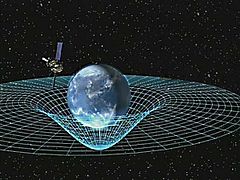
In physics, spacetime is any mathematical model that combines space and time into a single interwoven continuum. Since 300 BCE, the spacetime of our universe has historically been interpreted from a Euclidean space as consisting of three dimensions, and time as consisting of one dimension, the "fourth dimension". By combining space and time into a single manifold called Minkowski space in 1905, physicists have significantly simplified a large number of physical theories, as well as described in a more uniform way the workings of the universe at both the supergalactic and subatomic levels.
Source: Wikipedia
Black Hole
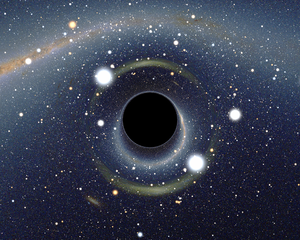
A black hole is a region of spacetime exhibiting such strong gravitational effects that nothing - including particles and electromagnetic radiation such as light - can escape from inside it. The theory of general relativity predicts that a sufficiently compact mass to form a black hole. The boundary of the region from which no escape is possible is called the event horizon. Although crossing the event horizon has enormous effect on the fate of the object crossing it, it appears to have no locality detectable features. In many ways a black hole acts like an ideal black body, as it reflects no light. Moreover, quantum field theory in curved spacetime predicts that event horizons emit Hawking Radiation, with the same kelvin for black holes of stellar mass, making it essentially impossible to observe.
Objects whose gravitational fields are too strong for light escape were first considered in the 18th century by John Michell and Pierre-Simon Laplace. The first modern solution of general relativity that would characterize a black hole was found by Karl Schwarzschild in 1916, although its interpretation as a region of space from which nothing can escape was first published by David Finkelstein in 1958. Black holes were long considered a mathematical curiosity; it was during the 1960s that theoretical work showed they were a generic prediction of general relativity. The discovery of neutron stars sparked interest in gravitationally collapsed compact objects as a possible astrophysical reality.
Black holes of stellar mass are expected to form when very massive stars collapse at the end of their life cycle. After a black hole has formed, it can continue to grow by absorbing mass from its surroundings. by absorbing other stars and merging with other black holes, supermassive black holes of millions of solar masses may form. There is general consensus that supermassive black holes exist in the centers of most galaxies.
Despite its invisible interior, the presence of a black hole can be inferred through its interaction with other matter and with electromagnetic radiation such as visible light. Matter that falls onto a black hole can form an external accretion disk heated by friction, forming some of the brightest objects in the universe. If there are other stars orbiting a black hole, their orbits can be used to determine the the black hole's mass and location. Such observations can be used to exclude possible alternatives such as neutron stars. In this way, astronomers have identified numerous stellar black hole candidates in binary system, and established that the ration source known as Sagittarius A*, at the core of our own Milky way galaxy, contains a supermassive black hole of about 4.3 million solar masses.
Source: Wikipedia
Source: Wikipedia
A Black Hole 660 million Times as Massive as Our Sun
A super massive black hole sits at the center of the galaxy NGC 1332, which is 73 million light years from the Earth. According to the research study it's about 660 million times as massive as our sun, and a cloud of gas circles it at about 1.1 mph.
Normally black holes are found at the centers of the galaxies and are so dense that their gravity pulls anything that is close enough, including light. A black hole can form after matter, often from an exploding star, condenses via gravity. Super massive black holes at the centers of galaxies grow by swallowing gas, stars and other black holes. But just because there is a black hole in your neighborhood, it does not act like a cosmic vacuum cleaner. Stars can come close to a black hole, but as long as they're in stable orbits and moving fast enough, they won't enter the black hole.The black hole at the center of the Milky Way is the biggest black hole of our own galaxy. But we are not going to stuck in it.
Scientists think every massive galaxy has a massive black hole at its center. The ubiquity of black holes is one indicator of the profound influence that they have on the formation of the galaxies in which they live.
Understanding the formation and evolution of galaxies is one of the major challenges for modern astrophysics. The scientists' findings have important implications for how galaxies and their central super massive black holes form. The ratio of a black hole's mass to a galaxy's mass is important in understanding their makeup. Research suggests that the growth of galaxies and the growth of their black holes are coordinated. And if we want to understand how galaxies form and evolve, we need to understand super massive black holes.
Part of understanding super massive black holes is measuring their exact masses. The lets scientists determine if a black hole is growing faster or slower than its galaxy. If black hole mass measurements are inaccurate, scientists can't draw any definitive conclusion.
To measure NGC 1332's central black hole, scientists tapped ALMA's high resolution observations of carbon monoxide emissions from a giant disc of cold gas orbiting the hole. They also measured the speed of the gas.
Black hole has been a very active area of research for the last 20 years for the astrophysicists. many research comes out these days about black holes. Lets see what we found about the black holes in the near future.
Source: Astrophysical Journal
Subscribe to:
Posts (Atom)