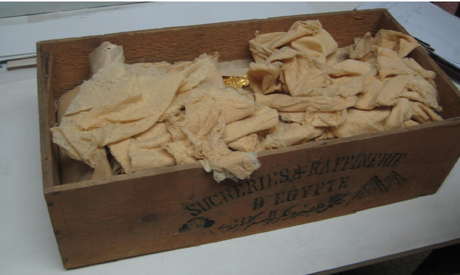
 LUXOR, EGYPT—Funded with a grant from the American Research Center in
Egypt Endowment Fund, Egypt’s Ministry of Antiquities will begin the
second phase of a study to identify a sarcophagus found in tomb KV55 in
the Valley of the Kings in 1906. The results of the first phase of the
study suggested that a box of 500 gold sheets, found in a storage room
at the Egyptian Museum in Tahrir, may belong to the KV55 sarcophagus. Ahram Online
reports that the remains of a skull and a note written in French were
found along with the box. Elham Salah, head of the ministry’s Museums
Department, says the note is dated to the time of the discovery of tomb
KV55, and it states that the gold sheets were discovered with a
sarcophagus.
LUXOR, EGYPT—Funded with a grant from the American Research Center in
Egypt Endowment Fund, Egypt’s Ministry of Antiquities will begin the
second phase of a study to identify a sarcophagus found in tomb KV55 in
the Valley of the Kings in 1906. The results of the first phase of the
study suggested that a box of 500 gold sheets, found in a storage room
at the Egyptian Museum in Tahrir, may belong to the KV55 sarcophagus. Ahram Online
reports that the remains of a skull and a note written in French were
found along with the box. Elham Salah, head of the ministry’s Museums
Department, says the note is dated to the time of the discovery of tomb
KV55, and it states that the gold sheets were discovered with a
sarcophagus.
Showing posts with label EGYPT. Show all posts
Showing posts with label EGYPT. Show all posts
Wednesday, 29 June 2016
Who Was Buried in Egypt’s KV55?
LUXOR, EGYPT—Funded with a grant from the American Research Center in
Egypt Endowment Fund, Egypt’s Ministry of Antiquities will begin the
second phase of a study to identify a sarcophagus found in tomb KV55 in
the Valley of the Kings in 1906. The results of the first phase of the
study suggested that a box of 500 gold sheets, found in a storage room
at the Egyptian Museum in Tahrir, may belong to the KV55 sarcophagus. Ahram Online
reports that the remains of a skull and a note written in French were
found along with the box. Elham Salah, head of the ministry’s Museums
Department, says the note is dated to the time of the discovery of tomb
KV55, and it states that the gold sheets were discovered with a
sarcophagus.
Solar Boat Timbers Removed from Giza Plateau Pit
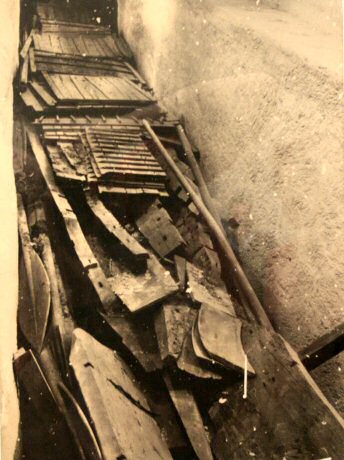 CAIRO, EGYPT—Conservators are restoring a second solar boat discovered
in 1954 in a pit beside the Great Pyramid of Khufu. The first boat was
found dismantled but arranged to resemble a boat, and was reconstructed.
A Japanese-Egyptian team began the restoration of the second boat in
2009. So far, they say they have documented and removed 700 of the 1,200
pieces of the boat from the pit’s 13 levels. Eissa Zidan, supervisor of
the restoration work, told Ahram Online
that the solar boats each had two shrines—one for the pharaoh at the
rear of the boat, and one for the captain, at the front of the boat.
Timbers removed from the pit recently may be the floors to the captain’s
shrine. “This is a great step forward in the conservation of Khufu’s
second boat,” Zidan said.
CAIRO, EGYPT—Conservators are restoring a second solar boat discovered
in 1954 in a pit beside the Great Pyramid of Khufu. The first boat was
found dismantled but arranged to resemble a boat, and was reconstructed.
A Japanese-Egyptian team began the restoration of the second boat in
2009. So far, they say they have documented and removed 700 of the 1,200
pieces of the boat from the pit’s 13 levels. Eissa Zidan, supervisor of
the restoration work, told Ahram Online
that the solar boats each had two shrines—one for the pharaoh at the
rear of the boat, and one for the captain, at the front of the boat.
Timbers removed from the pit recently may be the floors to the captain’s
shrine. “This is a great step forward in the conservation of Khufu’s
second boat,” Zidan said.Thursday, 2 June 2016
Egyptian Spells Deciphered
According to Discovery, two newly deciphered papyri from Egypt dating to the third century A. D. contain spells that deal with love and control.

The papyri, which were written in Greek, were discovered aas part of a larger cache more than 100 years ago in Oxyrhynchus, Egypt and have been gradually studied and translated since then. One spell instructs the spell caster to burn a number of offerings in a bathhouse and write a spell on its walls calling on the gods to burn the heart of a woman who has withheld her love. The other, designed to force a man to obey the caster's every command; instructs the caster to engrave a series of magical words onto a copper plaque and then affix it to something the man wears, such as a sandal.The spells were translated by Franco Maltomini of the University of Udine in Italy, and both were written so the caster could insert a target of their choice.
Friday, 20 May 2016
Nilometer
 |
| Nilometer |
It was a structure for measuring the Nile River's clarity and water level during the annual flood season. It was a step-like structure. IF it was low, there would be famine. If it was high it would be destructive. There was a specific mark that indicated how high the flood should be if the fields were to get soil.
 |
| ceiling of the Nilometer |
The ability to predict the volume of the coming inundation was part of the mystique of the Ancient Egyptian priesthood. The same skill also played a political and administrative role, since the quality of the year's flood was used to determine the levels of tax to be paid. This is where the nilometer came into play, with priests monitoring the day-to-day level of the river and announcing the awaited arrival of the summer flood.
Nilometer Discovered in Ancient Egyptian City
A Nilometer that was probably constructed in the third century B.C., during the reign of Ptolemies, was uncovered by workmen who are building a water pumping station in the ancient Egyptian city of Thmuis.
Nilometer was a device used by the ancient Egyptian to calculate the water level of the Nile River during its annual flood, and therefore predict the success of the harvest and compute the tax rate for the year. Rising water from the river may have flowed through a channel or from the rising water table, into the nilometer's circular well, which was accessed by a staircase. One of the large limestone blocks in the nilometer debars a list of Greek names followed by numbers which suggests that these people may have contributed funds to build it. Archaeologists suspect that it was originally located within a temple complex. They would have thought of the Nile River as a god and the nilometer was this point of interface between the spiritual and the pragmatic.
Subscribe to:
Posts (Atom)