 NEW YORK, NEW YORK—Climate change and the appearance of grasslands
coincided with the evolution of the first hominins, according to a study
led by Kevin Uno of Columbia University’s Lamont-Doherty Earth
Observatory. He and his team collected sediment cores dating back 24
million years from the bottom of the Red Sea and the western Indian
Ocean. Analysis of the chemicals in the sediments suggests that plants
that grew in East Africa, where the first hominins are thought to have
evolved, blew out to sea and sank. More than ten million years ago,
those plants came from dense forests. Chemicals linked to grasses slowly
began to appear in later layers of sediment. “This now gives us a
timeline for the development of those grasses, and tells us they were
part of our evolution from the very beginning,” Uno said in a UPI report.
NEW YORK, NEW YORK—Climate change and the appearance of grasslands
coincided with the evolution of the first hominins, according to a study
led by Kevin Uno of Columbia University’s Lamont-Doherty Earth
Observatory. He and his team collected sediment cores dating back 24
million years from the bottom of the Red Sea and the western Indian
Ocean. Analysis of the chemicals in the sediments suggests that plants
that grew in East Africa, where the first hominins are thought to have
evolved, blew out to sea and sank. More than ten million years ago,
those plants came from dense forests. Chemicals linked to grasses slowly
began to appear in later layers of sediment. “This now gives us a
timeline for the development of those grasses, and tells us they were
part of our evolution from the very beginning,” Uno said in a UPI report.
Showing posts with label AFRICA. Show all posts
Showing posts with label AFRICA. Show all posts
Wednesday, 29 June 2016
East Africa’s Vegetation Changes Detected in Marine Sediments
NEW YORK, NEW YORK—Climate change and the appearance of grasslands
coincided with the evolution of the first hominins, according to a study
led by Kevin Uno of Columbia University’s Lamont-Doherty Earth
Observatory. He and his team collected sediment cores dating back 24
million years from the bottom of the Red Sea and the western Indian
Ocean. Analysis of the chemicals in the sediments suggests that plants
that grew in East Africa, where the first hominins are thought to have
evolved, blew out to sea and sank. More than ten million years ago,
those plants came from dense forests. Chemicals linked to grasses slowly
began to appear in later layers of sediment. “This now gives us a
timeline for the development of those grasses, and tells us they were
part of our evolution from the very beginning,” Uno said in a UPI report.
Thursday, 2 June 2016
Meet Our newest Ancestors Homo Naledi
Homo Naledi
Domain : Eukarya
Kingdom : Animalia
Phylum : Chordata
Subphylum : Vertebrata
Class : Mammalia
Order : Primates
Family : Hominidae
Sub Family : Homininae
Tribe : Hominini
Subtribe : Hominina
Genus : Homo
Species : Homo Naledi
A team of Paleoanthropologists under Lee Berger went into the Rising Star Cave in Gauteng Province in South Africa in 2013 and till 2016 fossils were found there and these fossils have been proposed to represent he extinct species of the hominin Homo Naledi.

 The Rising Star Cave
The excavation team consisted six paleoanthropologists who were all female and could pass through an openeing only seven inches ( 18 cm ) wide to acess the Dinaledi chamber. Those chosen were Hannah Morris , Marina Elliot , Becca Peixotto , Alia Gurtov , Lindsay Eaves and Ellen Feuerriegel.
They have since been named the Underground Astronauts .
More than 1200 fossils were found in the Dinaledi Chamber and catalouged in November 2013 representing atleast a dozen individuals . Only 20 out of 206 bones of the human body were not found in the chamber.
As of September 2015 fossils of atleast 15 individuals , amounting to 1550 specimens , had been excavated from the cave. About 300 bone fragments were found from the surface of the Dinaledi Chamber and about 1250 fossil specimens were recovered from the chamber's excavation pit . The fossils include skull ,jaws , ribs , teeth , bones of an almost complete foot , of a hand and of an inner ear. The bones of old , young and infant individuals were found .

Anthropologist John D Hawkes from the University of Wisconsin Madinson who was a member of the team stated that the scientific facts are that all bones recovered are hominid except for those of an owl. There is no sign of predation and and there is no predator that accumulates only hominids this way and the bones were not accumulated here all at once . There is no evidence of rocks falling into the cave along with the bones or the bones having been flown here along with water . Lee Berger and his team have suggested that the best hypothesis that these individuals were capable of ritualistic behaviour . They speculate that the placing of dead bodies in the cave was a ritualistic behaviour , a sign of symbolic thought which implies that they had intelligence and were similar to human species
 The homo naledi fossils are the largest collection of fossils found of a single species of hominin in Africa and provides information about the early evolution of humans.
Picture Right - Skeletons Discovered
Domain : Eukarya
Kingdom : Animalia
Phylum : Chordata
Subphylum : Vertebrata
Class : Mammalia
Order : Primates
Family : Hominidae
Sub Family : Homininae
Tribe : Hominini
Subtribe : Hominina
Genus : Homo
Species : Homo Naledi
A team of Paleoanthropologists under Lee Berger went into the Rising Star Cave in Gauteng Province in South Africa in 2013 and till 2016 fossils were found there and these fossils have been proposed to represent he extinct species of the hominin Homo Naledi.
The excavation team consisted six paleoanthropologists who were all female and could pass through an openeing only seven inches ( 18 cm ) wide to acess the Dinaledi chamber. Those chosen were Hannah Morris , Marina Elliot , Becca Peixotto , Alia Gurtov , Lindsay Eaves and Ellen Feuerriegel.
They have since been named the Underground Astronauts .
More than 1200 fossils were found in the Dinaledi Chamber and catalouged in November 2013 representing atleast a dozen individuals . Only 20 out of 206 bones of the human body were not found in the chamber.
As of September 2015 fossils of atleast 15 individuals , amounting to 1550 specimens , had been excavated from the cave. About 300 bone fragments were found from the surface of the Dinaledi Chamber and about 1250 fossil specimens were recovered from the chamber's excavation pit . The fossils include skull ,jaws , ribs , teeth , bones of an almost complete foot , of a hand and of an inner ear. The bones of old , young and infant individuals were found .
ARTISTS IMPRESSION OF THE HOMO NALEDI
Anthropologist John D Hawkes from the University of Wisconsin Madinson who was a member of the team stated that the scientific facts are that all bones recovered are hominid except for those of an owl. There is no sign of predation and and there is no predator that accumulates only hominids this way and the bones were not accumulated here all at once . There is no evidence of rocks falling into the cave along with the bones or the bones having been flown here along with water . Lee Berger and his team have suggested that the best hypothesis that these individuals were capable of ritualistic behaviour . They speculate that the placing of dead bodies in the cave was a ritualistic behaviour , a sign of symbolic thought which implies that they had intelligence and were similar to human species
Picture Right - Skeletons Discovered
Friday, 20 May 2016
Painted Medieval Church Walls Discovered in Norther Sudan
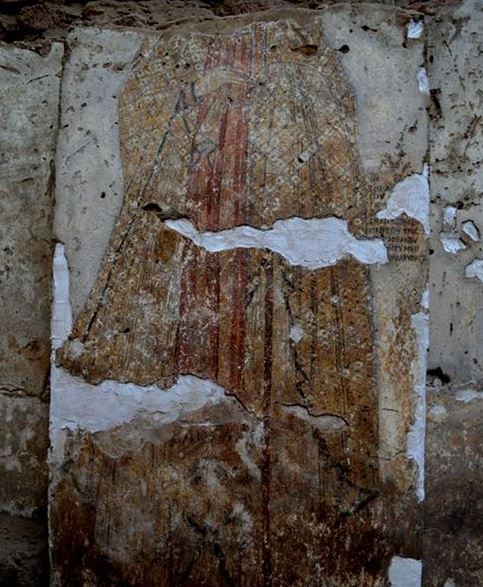 A team from the Center of Mediterranean Archeology at the University of Warsaw is excavating the church of Raphael, part of a royal complex of buildings at the site of Dongola, the capital of Makuria which is a medieval kingdom located in what is now northern Sudan. The church's pulpit was made with hieroglyph-inscribed granite blocks repurposed from a pharaonic temple.Images of archangels, angels , priests, saints and officials of the Nubian kingdom were painted on smooth lime wall plaster with expensive pigments. Each person depicted in the paintings was also identified and described, One of the inscriptions records a meeting at the church attended by the bishops of Makuria, the archbishop of Dongola and the king.
According to the researchers, the church was founded by king Joannes, until now nothing much is known about him. The inscription proves that he was an important person in the hierarchy of the church and had considerable political influence.
Nilometer
 |
| Nilometer |
It was a structure for measuring the Nile River's clarity and water level during the annual flood season. It was a step-like structure. IF it was low, there would be famine. If it was high it would be destructive. There was a specific mark that indicated how high the flood should be if the fields were to get soil.
 |
| ceiling of the Nilometer |
The ability to predict the volume of the coming inundation was part of the mystique of the Ancient Egyptian priesthood. The same skill also played a political and administrative role, since the quality of the year's flood was used to determine the levels of tax to be paid. This is where the nilometer came into play, with priests monitoring the day-to-day level of the river and announcing the awaited arrival of the summer flood.
Nilometer Discovered in Ancient Egyptian City
A Nilometer that was probably constructed in the third century B.C., during the reign of Ptolemies, was uncovered by workmen who are building a water pumping station in the ancient Egyptian city of Thmuis.
Nilometer was a device used by the ancient Egyptian to calculate the water level of the Nile River during its annual flood, and therefore predict the success of the harvest and compute the tax rate for the year. Rising water from the river may have flowed through a channel or from the rising water table, into the nilometer's circular well, which was accessed by a staircase. One of the large limestone blocks in the nilometer debars a list of Greek names followed by numbers which suggests that these people may have contributed funds to build it. Archaeologists suspect that it was originally located within a temple complex. They would have thought of the Nile River as a god and the nilometer was this point of interface between the spiritual and the pragmatic.Tuesday, 25 August 2015
Most Big Animals Tried Grass but Many Switched Diet or Extinct
As grasses grew more common in Africa, most major mammal group tried grazing on them at times during the past four million years, but some of the animals went extinct or switched back to browsing on trees and shrubs.

Subscribe to:
Posts (Atom)