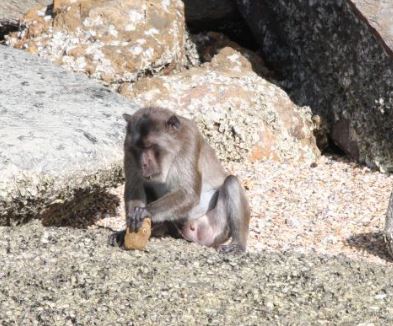
 OXFORD, ENGLAND—The wild macaques of coastal Thailand have been using stones as tools for generations, according to a UPI
report. Scientists led by Michael Haslam of the University of Oxford
observed the monkeys searching for good stones and using them to process
oysters, snails, nuts, and crabs. When particular stones worked well,
the monkeys placed them near the boulders where they preferred to eat.
The researchers then examined the marks on the stones and excavated the
area to look for similar ones. They found identical marks on stones in a
layer with oyster shells that were carbon-dated to between ten and 50
years ago. “As we build up a fuller picture of their evolutionary
history, we will start to identify the similarities and differences in
human behavior and that of other primates,” Haslam explained.
OXFORD, ENGLAND—The wild macaques of coastal Thailand have been using stones as tools for generations, according to a UPI
report. Scientists led by Michael Haslam of the University of Oxford
observed the monkeys searching for good stones and using them to process
oysters, snails, nuts, and crabs. When particular stones worked well,
the monkeys placed them near the boulders where they preferred to eat.
The researchers then examined the marks on the stones and excavated the
area to look for similar ones. They found identical marks on stones in a
layer with oyster shells that were carbon-dated to between ten and 50
years ago. “As we build up a fuller picture of their evolutionary
history, we will start to identify the similarities and differences in
human behavior and that of other primates,” Haslam explained.
Showing posts with label ENGLAND. Show all posts
Showing posts with label ENGLAND. Show all posts
Wednesday, 29 June 2016
Scientists Unearth Macaque “Tools” in Thailand
OXFORD, ENGLAND—The wild macaques of coastal Thailand have been using stones as tools for generations, according to a UPI
report. Scientists led by Michael Haslam of the University of Oxford
observed the monkeys searching for good stones and using them to process
oysters, snails, nuts, and crabs. When particular stones worked well,
the monkeys placed them near the boulders where they preferred to eat.
The researchers then examined the marks on the stones and excavated the
area to look for similar ones. They found identical marks on stones in a
layer with oyster shells that were carbon-dated to between ten and 50
years ago. “As we build up a fuller picture of their evolutionary
history, we will start to identify the similarities and differences in
human behavior and that of other primates,” Haslam explained.
Sunday, 26 June 2016
Monumental Structure Found at Petra with Satellite Images
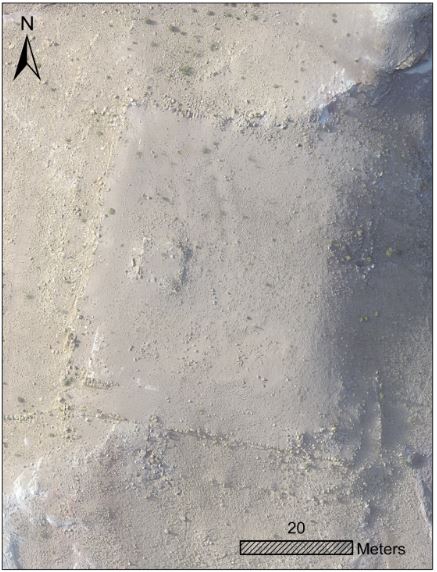 BIRMINGHAM, ALABAMA—Sarah Parcak of the University of Alabama at
Birmingham, and Christopher Tuttle, executive director of the Council of
American Overseas Research Centers, spotted a monumental structure at
Petra, a 2,500-year-old Nabatean city in southern Jordan, using
high-resolution satellite imagery and pictures taken with aerial drones.
National Geographic
reports that the structure consists of a building measuring roughly 28
feet square, centered on a rectangular, paved platform, surrounded by a
larger, 184-by-161-foot, platform. The building faced a row of columns
and a staircase to the east. Pottery recovered from the site dates to
the mid-second century B.C. Parcak and Tuttle say that the platform’s
design is unique in the ancient city, and may have been used for
ceremonial purposes in the early days of the settlement. “I’ve worked in
Petra for 20 years, and I knew that something was there, but it’s certainly legitimate to call this a discovery,” Tuttle said.
BIRMINGHAM, ALABAMA—Sarah Parcak of the University of Alabama at
Birmingham, and Christopher Tuttle, executive director of the Council of
American Overseas Research Centers, spotted a monumental structure at
Petra, a 2,500-year-old Nabatean city in southern Jordan, using
high-resolution satellite imagery and pictures taken with aerial drones.
National Geographic
reports that the structure consists of a building measuring roughly 28
feet square, centered on a rectangular, paved platform, surrounded by a
larger, 184-by-161-foot, platform. The building faced a row of columns
and a staircase to the east. Pottery recovered from the site dates to
the mid-second century B.C. Parcak and Tuttle say that the platform’s
design is unique in the ancient city, and may have been used for
ceremonial purposes in the early days of the settlement. “I’ve worked in
Petra for 20 years, and I knew that something was there, but it’s certainly legitimate to call this a discovery,” Tuttle said.Friday, 24 June 2016
Bronze Wing May Have Graced Roman Victory Statuette
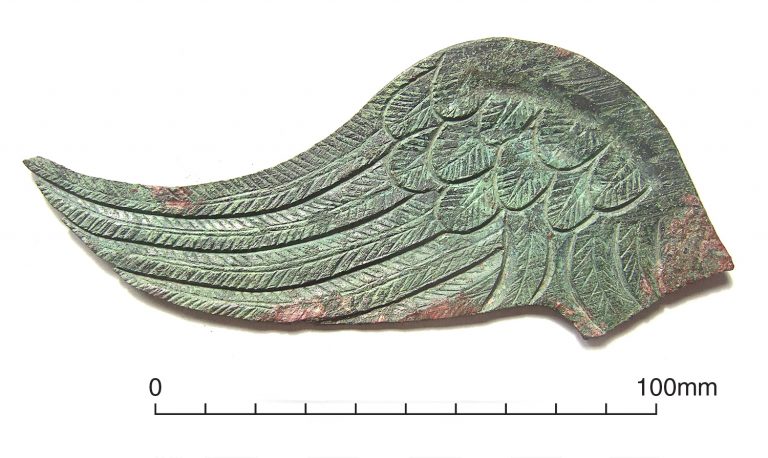 GLOUCESTER, ENGLAND—A bronze wing measuring 5.5 inches long has been
unearthed in southwestern England. At first it had been thought that the
wing, discovered in an earthen bank behind what would have been the
Roman city wall, was part of an eagle statue. But Martin Henig of Oxford
University has concluded that the wing was actually part of a Roman
statuette of Victoria, the goddess of victory. “It would be nice to
think a retired Roman soldier, spending his retirement years in
Gloucester, had a nice statuette to Victory as thanks for making it
through the Roman invasion of Britain in one piece,” Neil Holbrook of
Cotswold Archaeology said in a BBC News report.
GLOUCESTER, ENGLAND—A bronze wing measuring 5.5 inches long has been
unearthed in southwestern England. At first it had been thought that the
wing, discovered in an earthen bank behind what would have been the
Roman city wall, was part of an eagle statue. But Martin Henig of Oxford
University has concluded that the wing was actually part of a Roman
statuette of Victoria, the goddess of victory. “It would be nice to
think a retired Roman soldier, spending his retirement years in
Gloucester, had a nice statuette to Victory as thanks for making it
through the Roman invasion of Britain in one piece,” Neil Holbrook of
Cotswold Archaeology said in a BBC News report.Scientists Say “Lost City” Formed by Natural Phenomenon
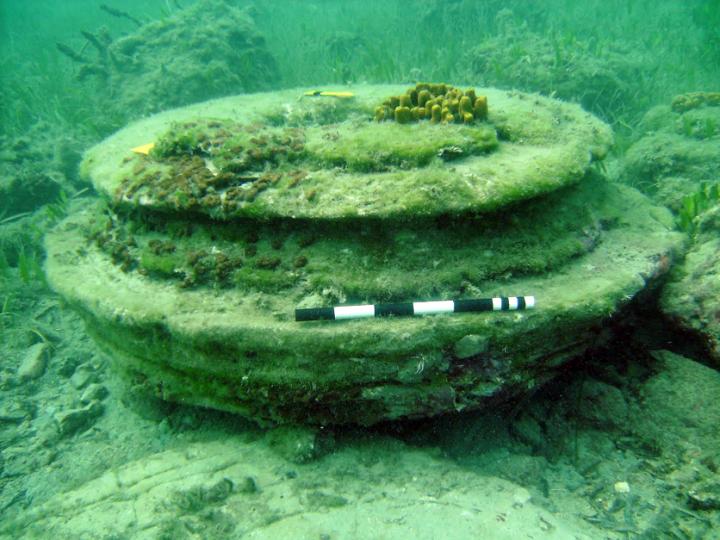 NORWICH, ENGLAND—Scientists from the University of Athens and the
University of East Anglia say that what looked like the paved floors,
courtyards, and colonnades of a lost city in shallow waters off the
coast of the Greek island Zakynthos were actually created by a natural
geological phenomenon up to five million years ago. According to a
report in Tech Times,
Julian Andrews of the University of East Anglia noticed that there
wasn’t any pottery or other signs of human activity around the supposed
ruins, which were discovered by recreational divers. The researchers
took a closer look at the mineral content and texture of the stones with
X-rays, microscopy, and stable isotope techniques. They think the
column-shaped concretions are the result of mineralization at
hydrocarbon seeps along a fault under the seabed. Microbes in the
seafloor sediments used the methane and other gases from the fault as
fuel, changing the chemistry of the sediment and forming the
concretions. Erosion eventually exposed and shaped the concretions.
“This kind of phenomenon is quite rare in shallow waters,” Andrews said.
“Most similar discoveries tend to be many hundreds and often thousands
of meters deep underwater.”
NORWICH, ENGLAND—Scientists from the University of Athens and the
University of East Anglia say that what looked like the paved floors,
courtyards, and colonnades of a lost city in shallow waters off the
coast of the Greek island Zakynthos were actually created by a natural
geological phenomenon up to five million years ago. According to a
report in Tech Times,
Julian Andrews of the University of East Anglia noticed that there
wasn’t any pottery or other signs of human activity around the supposed
ruins, which were discovered by recreational divers. The researchers
took a closer look at the mineral content and texture of the stones with
X-rays, microscopy, and stable isotope techniques. They think the
column-shaped concretions are the result of mineralization at
hydrocarbon seeps along a fault under the seabed. Microbes in the
seafloor sediments used the methane and other gases from the fault as
fuel, changing the chemistry of the sediment and forming the
concretions. Erosion eventually exposed and shaped the concretions.
“This kind of phenomenon is quite rare in shallow waters,” Andrews said.
“Most similar discoveries tend to be many hundreds and often thousands
of meters deep underwater.”Thursday, 2 June 2016
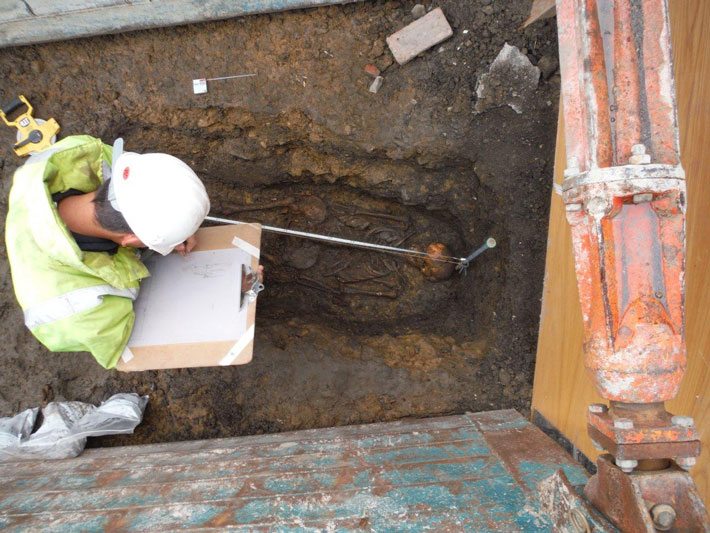
Industrial Revolution Era Burials Found in England
Excavations at the site of a future shopping center in Leeds have revealed the burials of at least 28 people, mainly children, who died between 1797 and 1848.
 According to a report published in Yorkshire Evening Post, analysis of the remains shows that the people were in extremely poor health and some may have possibly died during an 1832 cholera outbreak. The condition pf the remains confirms that living conditions in the city were particularly grim for the lower classes.
Bio-archaeologists found that at least nine of the children suffered from diseases such as rickets and scurvy.
 According to a report published in Yorkshire Evening Post, analysis of the remains shows that the people were in extremely poor health and some may have possibly died during an 1832 cholera outbreak. The condition pf the remains confirms that living conditions in the city were particularly grim for the lower classes.
Bio-archaeologists found that at least nine of the children suffered from diseases such as rickets and scurvy.
Friday, 20 May 2016
Roman Baths in England
Archaeologists excavating rarely seen areas of the Roman Baths under York street and Swallow Street have found traces of red-painted plaster on the outside wall of the Great Bath. According to a report in The Bath Chronicle, the building may have been painted that color during the Roman period. Samples of that excavation have been sent to Bournemoouth University for analysis.

The team has also found evidence of the earliest phases of the Roman Baths, a second bath beneath York Street, the footings of create a new learning center and a World Heritage Center.
Scientists Assess Skulls in Prehistoric and Modern Population
Cribra orbitalia (CO), a condition in which the bone inside the eye sockets becomes porous, can be caused by iron deficiency anemia and is often used by anthropologists to assess the health and diet of prehistoric populations. It had been thought that this condition might have gone extinct but when anthropologists from North Carolina Sate University and the University of the Witwatersrand examined 844 modern, historic and prehistoric human adult and juvenile skulls for the prevalence of CO, they were surprised to find higher rates of CO in modern populations in both North America and South Africa.

The team suggests that access to adequate nutrition and the presence of intestinal parasites are still problems for disadvantaged socioeconomic groups and parts of the developing world. To read in depth about the bio-archaeology of disadvantaged people in nineteenth-century London.
Monday, 8 June 2015
Many UK patients with gonorrhea prescribed outdated antibiotics
Many UK patients with gonorrhea are being prescribed antibiotics that
are no longer recommended for treating the infection by their family
doctor, reveals research published in the online journal BMJ Open.
This failure to keep abreast of national clinical guidance is of
concern, given the global threat of antibiotic resistance, say the
researchers.
They base their findings on an analysis of electronic health records entered anonymously into the Clinical Practice Research Datalink-- a large database containing the health records of around 5.5 million patients registered with 680 general practices around the UK--as well as information from anonymous monitoring of sexually transmitted infections in England.
They looked particularly at how doctors in general practice had treated the two most commonly diagnosed bacterial sexually transmitted infections in England, Chlamydia and gonorrhoea, between 2000 and 2011.
GPs diagnosed an estimated 193,000 people with Chlamydia and nearly 17,000 with gonorrhoea during this period, accounting for between 9% and16% of all Chlamydia cases and between 6% and 9% of all gonorrhoea cases in England.
The number of diagnoses GPs made for Chlamydia rose substantially from 22.8/100,000 of the population in 2000 to 29.3/100,000 of the population in 2011. And the proportion of patients treated for this infection rose from around six in every 10 (60%) to almost eight out of 10 (78%).
Most (90%) were prescribed an antibiotic recommended in national clinical guidance. But this was not the case for gonorrhoea.
The number of diagnoses fluctuated between 3.2 to 2.4/100,000 of the population, while the proportion treated ranged between a third (just under 33%) and just over half (54%).
Despite being discontinued as a recommended treatment for the infection in 2005, ciprofloxacin continued to be prescribed. This antibiotic accounted for more than four out of 10 prescriptions (42%) in 2007, and one in five in 2011.
The bacterium that causes gonorrhoea, Neisseria gonorrhoeae, is adept at developing resistance to the antibiotics used to treat it, and the evidence from other research shows that over a third of gonorrhoea infections treated at sexual health clinics were resistant to ciprofloxacin, for example, while up to one in five cases may be resistant to penicillin.
The researchers conclude that GPs make an important contribution to the diagnosis and treatment of bacterial sexually transmitted infections, but while most patients with Chlamydia are treated appropriately, "significant numbers" of those infected with gonorrhoea are not.
"Treatment of infections with reduced susceptibility or resistance to the prescribed therapy may inadvertently facilitate onward transmission and risks infection complications," they write.
"Antimicrobial resistance in gonorrhoea is a global problem and may become an issue for Chlamydia in future," they warn. "Practitioners should be alert to the likelihood of revisions to national treatment guidelines and of treatment failure in their patients."
They base their findings on an analysis of electronic health records entered anonymously into the Clinical Practice Research Datalink-- a large database containing the health records of around 5.5 million patients registered with 680 general practices around the UK--as well as information from anonymous monitoring of sexually transmitted infections in England.
They looked particularly at how doctors in general practice had treated the two most commonly diagnosed bacterial sexually transmitted infections in England, Chlamydia and gonorrhoea, between 2000 and 2011.
GPs diagnosed an estimated 193,000 people with Chlamydia and nearly 17,000 with gonorrhoea during this period, accounting for between 9% and16% of all Chlamydia cases and between 6% and 9% of all gonorrhoea cases in England.
The number of diagnoses GPs made for Chlamydia rose substantially from 22.8/100,000 of the population in 2000 to 29.3/100,000 of the population in 2011. And the proportion of patients treated for this infection rose from around six in every 10 (60%) to almost eight out of 10 (78%).
Most (90%) were prescribed an antibiotic recommended in national clinical guidance. But this was not the case for gonorrhoea.
The number of diagnoses fluctuated between 3.2 to 2.4/100,000 of the population, while the proportion treated ranged between a third (just under 33%) and just over half (54%).
Despite being discontinued as a recommended treatment for the infection in 2005, ciprofloxacin continued to be prescribed. This antibiotic accounted for more than four out of 10 prescriptions (42%) in 2007, and one in five in 2011.
The bacterium that causes gonorrhoea, Neisseria gonorrhoeae, is adept at developing resistance to the antibiotics used to treat it, and the evidence from other research shows that over a third of gonorrhoea infections treated at sexual health clinics were resistant to ciprofloxacin, for example, while up to one in five cases may be resistant to penicillin.
The researchers conclude that GPs make an important contribution to the diagnosis and treatment of bacterial sexually transmitted infections, but while most patients with Chlamydia are treated appropriately, "significant numbers" of those infected with gonorrhoea are not.
"Treatment of infections with reduced susceptibility or resistance to the prescribed therapy may inadvertently facilitate onward transmission and risks infection complications," they write.
"Antimicrobial resistance in gonorrhoea is a global problem and may become an issue for Chlamydia in future," they warn. "Practitioners should be alert to the likelihood of revisions to national treatment guidelines and of treatment failure in their patients."
This story is taken from Science Daily
Tuesday, 2 June 2015
Britain’s oldest sauropod dinosaur identified from fossil bone that fell from a cliff face
Experts have identified Britain's oldest sauropod dinosaur from a fossil
bone discovered on the Yorkshire coast. The vertebra (backbone)
originates from a group of dinosaurs that includes the largest land
animals to have ever walked on Earth. This new sauropod dinosaur, from
the Middle Jurassic Period at about 176 million years old, was found
near Whitby, Yorkshire, after it fell out of a cliff face. This find
represents the earliest skeletal record of this type of dinosaur from
the United Kingdom and adds to existing evidence from Yorkshire dinosaur
tracks that this part of the country was once Britain's very own
'Jurassic World'.

The vertebra (backbone) originates from a group of dinosaurs that
includes the largest land animals to have ever walked on Earth. This new
sauropod dinosaur, from the Middle Jurassic Period at about 176 million
years old, was found near Whitby, Yorkshire, after it fell out of a
cliff face. This find represents the earliest skeletal record of this
type of dinosaur from the United Kingdom and adds to existing evidence
from Yorkshire dinosaur tracks that this part of the country was once
Britain's very own 'Jurassic World'.
Sauropods (often referred to as 'brontosaurs') include some of the largest plant-eating dinosaurs to have roamed the Earth and were a successful group for nearly 150 million years. They possessed distinctive long necks and tails, small heads, a large body and walked on all fours. Some species such as the Argentinosaurus grew up to 115 feet (35 metres) long and possibly weighed as much as 80 tonnes.
The fragmentary nature of the new find from Yorkshire means it is not possible to generate a new species of dinosaur. However, this fossil clearly belongs to this distinctive group of titanic sized animals, the sauropods. This dinosaur fossil is an extremely rare find, given the Middle Jurassic rocks of the world are only exposed in a few areas, such as China and Argentina where similar-aged dinosaur fossils originate.
Professor Phil Manning and his team from The University of Manchester used X-Ray Tomography to study the fossil bone, which is now held in the collections at the Yorkshire Museum in York (UK). They present their description of this new sauropod dinosaur in a paper published today in the journal PLOS ONE.
Professor Manning said: "Many scientists have worked on the amazing dinosaur tracks from the Middle Jurassic rocks of Yorkshire. It was a splendid surprise to come face-to-face with a fossil vertebra from the Jurassic rocks of Yorkshire that was clearly from a sauropod dinosaur
"This fossil offers the earliest 'body fossil' evidence for this important group of dinosaurs in the United Kingdom, but it is impossible to define a new species based upon this single bone."
Whilst this is clearly frustrating for the team, there is possibly more of this Jurassic titan still to be discovered in the future and only then might it get a new species name. Until more bones are discovered the team have simply nicknamed Britain's oldest sauropod dinosaur, 'Alan', after the finder of this prehistoric beastie (Alan Gurr).
Dr Victoria Egerton (co-author on the paper) added: "The Jurassic Park that was once Yorkshire clearly has much more to offer science in our understanding of the distribution and evolution of dinosaurs."
Dr Mike Romano, another co-author on the paper said: "Dinosaur remains of Middle Jurassic age are generally rare, even on a global scale. So, to find a single distinctive vertebra of that age on the beach at Whitby, and one that represents a new taxon of sauropod dinosaurs, is indeed a (white) feather in the cap for Yorkshire."
Sauropods (often referred to as 'brontosaurs') include some of the largest plant-eating dinosaurs to have roamed the Earth and were a successful group for nearly 150 million years. They possessed distinctive long necks and tails, small heads, a large body and walked on all fours. Some species such as the Argentinosaurus grew up to 115 feet (35 metres) long and possibly weighed as much as 80 tonnes.
The fragmentary nature of the new find from Yorkshire means it is not possible to generate a new species of dinosaur. However, this fossil clearly belongs to this distinctive group of titanic sized animals, the sauropods. This dinosaur fossil is an extremely rare find, given the Middle Jurassic rocks of the world are only exposed in a few areas, such as China and Argentina where similar-aged dinosaur fossils originate.
Professor Phil Manning and his team from The University of Manchester used X-Ray Tomography to study the fossil bone, which is now held in the collections at the Yorkshire Museum in York (UK). They present their description of this new sauropod dinosaur in a paper published today in the journal PLOS ONE.
Professor Manning said: "Many scientists have worked on the amazing dinosaur tracks from the Middle Jurassic rocks of Yorkshire. It was a splendid surprise to come face-to-face with a fossil vertebra from the Jurassic rocks of Yorkshire that was clearly from a sauropod dinosaur
"This fossil offers the earliest 'body fossil' evidence for this important group of dinosaurs in the United Kingdom, but it is impossible to define a new species based upon this single bone."
Whilst this is clearly frustrating for the team, there is possibly more of this Jurassic titan still to be discovered in the future and only then might it get a new species name. Until more bones are discovered the team have simply nicknamed Britain's oldest sauropod dinosaur, 'Alan', after the finder of this prehistoric beastie (Alan Gurr).
Dr Victoria Egerton (co-author on the paper) added: "The Jurassic Park that was once Yorkshire clearly has much more to offer science in our understanding of the distribution and evolution of dinosaurs."
Dr Mike Romano, another co-author on the paper said: "Dinosaur remains of Middle Jurassic age are generally rare, even on a global scale. So, to find a single distinctive vertebra of that age on the beach at Whitby, and one that represents a new taxon of sauropod dinosaurs, is indeed a (white) feather in the cap for Yorkshire."
This story is taken from Science Daily
Subscribe to:
Posts (Atom)