Showing posts with label Prehistoric Animals. Show all posts

Tuesday, 10 May 2016

Nothrotheriops

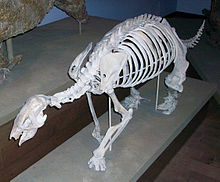
Nothrotheriops skeleton at Springs Preserve.jpg

Kingdom: Animalia
Phylum: Chordata
Class: Mammalia
Order: Xenarthra
Genus: Nothrotheriops
Species: N. shastensis
               N. texanus
Temporal Range: 2.6 - 0.011 ma

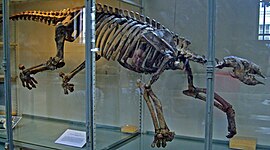
It is a genus of Pleistocene ground sloth found in North America, from what is now central Mexico to the southern United states. This genus of bear-sized xenarthran was related ti the much larger and far more famous Megatherium which was from the family Megatheriidae 
It was one of the smallest ground sloth species, it reached 9 ft from head to tail and weighted 550 lb which is much smaller than some of its contemporary species such as the Eremotherium, which could easily weigh over two tons and be 20 ft long. It had large, stout hind legs and a powerful, muscular tail that it used to forn a supporting tripod whenever it shifted from a quadrupedal stance to a bipedal one.
This genus's lineage dates back to the Miocene The ancestors of Nothrotheriops migrated to North America from South America as part of the Great American Interchange about 2.6 million years ago.
The best known historical specimen was found in a lava tube at Aden Crater in New Mexico; It was found with hair and tendon still preserved. Rampart Cave, in the Grand Canyon, Arizona has a plentiful amount of the sloth's hair and dung which allowed the scientists both to use radiocarbon dating techniques to establish when it lived. The most recent credible dates from this and each of about half a dozen other southwestern caves are about 11,000 BP.
It behaved like all typical ground sloths of North and South America, feeding on various plants like the desert globemallow, cacti and yucca. It was hunted by various local predators. Like Smilodon, from which the sloths may have defended themselves by standing upright on hindlegs and tail and swiping with their long foreclaws, like its distant relative Megatherium. The same claws could also been used as tools to reach past the plant spines and grab softer flowers and fruits. Also the have had a prehensile tongue like a giraffe to strip leaves off branches.
This sloth is believed to have played an important role in the dispersal of Joshua tree,seeds. Preserved dung belonging to the sloth has been found to contain Joshua tree leaves and seeds, confirming that they fed on the trees. It has been suggested that the lack of this ground sloths helping to disperse the seeds to more favourable climates is causing the trees to suffer.

Nothropus

Kingdom: Animalia
Phylum: Chordata
Class: Mammalia
Order: Pilosa
Family: Northorotheriidae
Genus: Nothoropus
Temporal Range: Early Pleistocene - Early Holocene

Nothropus is extinct genus of ground sloth of the family Nothrotheriidae, endemic to South America during the Pleistocene epoch. It lived from 0.781 mya - 12,000 years ago existing for approximately 0.769 million years.
Fossils have been uncovered from Tarija, Bolivia, east side of the Andes Mountains.

Thalassocnus

Thalassocnus.jpg

Kingdom: Animalia
Phylum:  Chordata
Class: Mammalia
Order: Pilosa
Genus: Thalassocnus
Species: T. antiquus
               T. natans
               T. littoralis
               T. carolomartini
               T. Yaucensis
Temporal Range: Late Miocene to Late Pliocene

It is an extinct genus of semi-aquatic or fully aquatic marine sloth from the Miocene and Pliocene of South America. Fossils found to date have been from the coast of Peru and Chile. They were apparently grazers of sea grass and seaweed. The various species of this genus provides the best-documented case of gradual adaptation ti a secondary aquatic lifestyle. This is documented both at the morphological level, such as a progressive flattening of the radius.and at the micro anatomical level, which shows a progressive increase in thickness and compactness of the long limb bones and ribs, providing ballast. They may have used their powerful claws to anchor themselves to the sea floor to facilitate feeding, simmilar to the behavior of the marine iguana.
The oldest species, T. antiquus, T. natans and T. littoralis show indications of partial adaptation to grazing with little evidence of transverse mandibular movement while eating, and abundant dental striae indicating ingestion of sand from feeding on vegetation stranded on beaches or or in shallow water. The later species T. carolomartini and T. yaucensis were apparently specialized grazers that fed in deeper water, they display distinct evidence of transverse mandibular movement and lack dental striae.

Mionothropus


Kingdom:  Animalia
Phylum: Chordata
Class: Mammalia
Order: Xenarthra
Family: Nothrotheriidae
Genus: Mionothropus
Species: M. cartellei
Temporal Range: 7.9 Ma

It is an extinct genus of the sloth family Nothrotheriinae which existed in Peru in western Amazonia, during the late Miocene. 

Nothrotheriidae


Kingdom: Animalia
Phylum: Chordata
Class: Mammalia
Order: Pilosa
Family: Nothrotheriidae
Temporal Range: 11.6 - 0.011 Ma

It is a family of extinct ground sloths that lived from approximately 11.6 mya - 11,000 years ago. During the late Miocene and Pliocene, the nothrotheriid Thalassocnus of the west coast of South America became adapted to a shallow water marine lifestyle.
The earliest nothrotheriid in North America was Nothrotheriops, which appeared at the beginning of the Pleistocene, about 2.6 Ma ago. Nothrotherium reached Mexico by the late Pleistocene.
The last ground sloths in North America belonging to Nothrotheriops died so recently that their dried subfossil dung has remained undisturbed in some caves, as if it were just recently deposited. 
The largest samples of Nothrotheriops dung can be found in the collections of Smithsonian Museum.

Genus:

Sunday, 8 May 2016

Pelecyodon

Pelecyodon cristatus.JPG

Kingdom: Animalia
Phylum: Chordatat
Class: Mammalia
Order: Pilosa
Family: Megatheriiidae
Genus: Pelecyodon
Species: P. arcuatus
               P. cristatus
               P. maximus
               P. petraeus
               P. robustus
Temporal Range: Late Oligocene - Miocene

Pelecyodon is an extinct genus of ground sloth from the late Oligocene of South America.

Prepotherium

Kingdom:  Animalia
Phylum: Chordata
Class: Mammalia
Order: Pilosa
Family: Megatheriidae
Genus: Prepotherium
Temporal Range: Prepotherium

Prepotherium is an extinct genus of Prepotheriina ground sloths that lived during the Miocene period. Fossils of them have been found in Argentina. Prepotherium differed from Megatherium by being smaller and having a less exaggeratedly convex inferior border of the lower jaw.
This species was reclassified in their own genus, Pseudoprepotherium as a basal member of another family of ground sloths, the Mylodontidae.

Promegatherium

Promegatherium nanum.JPG

Kingdom: Animalia
Phylum: Chordata
Class: Mammalia
Order: Xenarthra
Family: Megatheriidae
Genus: Promegatherium
Species: P. cabreri
               P. nanum

               P. parvulum
               P. remulsum
               P. smaltatum
 Temporal Range: Miocene Epoch
Promegatherium is a genus of prehistoric sloth that lived in South America, primarily Argentina during the Middle to upper Miocene. This genus is regarded as closely related to the later anmd more famous genus, Megatherium, hence the reference in the name. The first specimens of Promegatherium were originally described by the biologist Florentino Ameghino in 1887.

Tuesday, 25 August 2015

Widest Distribution of Mammoth during the Last Ice Age

Ice Age paleontologist recorded the maximum geographical distribution of the woolly mammoth during the last Ice Age and published the most accurate global map in this regard. A total distribution area of 33,301,000 square kilometers and may thus be called the most successful large mammals of this era. The study determined that the distribution was limited by a number of climate driven as well as climate-independent factors.

Woolly Mammoth Tusk

Source : Science Daily

Sunday, 23 August 2015

Early Dogs drove to Extinction by the Cats

The dogs family originated in North America 40 Million of years ago and reached a maximum diversity around 22 million of years ago, when more than 30 species inhabited the continent. Today only 9 species of them lived in North America. They progressively increased in body size and species and specialized into becoming large predator. Some of them exceeded 30 kg and were among the largest carnivore on the North American continent. Although there are several large carnivores today face a higher extinction risk than smaller species, the author of the study found no evidence of a similar pattern in ancient canid species.

In the ancient times in the North America the canid species and the felid species fights for the same food just what we see in the Africa today where lions, leopards, Hyenas, wild dogs and other carnivores. New researches revealed that the ancient felids have strong negative impacts on the survivals of the ancient dogs but the opposite is not true. 

This also proved that the ancient felid species are much more efficient hunters than the ancient dogs.

Source: University of Gothenberg

Wednesday, 19 August 2015

We are Responsible for the Extinction of the Mega Fauna

Scientists claimed their research settles a prolonged debate over mankind or  climate change was the dominate cause of the demise of massive creatures in the time of the saber-tooth, the woolly mammoth, the Woolly Rhinos and the giant armadillo.

Woolly Mammoth
Early human were the dominate cause of the extinction of a variety of species of giant beasts. 

Source: University of Exeter 

Tuesday, 11 August 2015

Ancient Reptiles Attacked with Giant Fangs

According to the researchers the Giant ancient Prehistorical mammal like reptiles that grazed across the globe in the Permian Period may have possessed many of the fighting tactics seen in mordern herbivores, including head butting and attacks with the giant fangs. A number of these extinct beasts also possessed complex molar like teeth on the roof of their mouth.

Two fighting Tiarajudens eccentricus, which were odd saber-toothed reptiles.

About 250 to 300 million years ago, right before the Age of Dinosaurs the most successful vertebrates on land were the ancestors of mammals - also known as the primitive therapsids that are sometimes called mammal-like reptiles. These ancient creatures includes anomodonts,

Monday, 10 August 2015

After KT extinction Age of Modern Fishes rises

According to two paleontologist, working in the National Academy of Science have determined that the world's most numerous and diverse vertebrate - ray finned fishes - began their ecological dominance of the oceans 66 million years ago, aided by the KT mass extinction event that killed of the Dinosaurs.

An assortment of Early Cenozoic ichthyoliths.

Entire Genomes of Wooly Mammoth Mapped

A international team of researcher has sequenced the nearly complete genome of two Siberian wooly mammoths. It revealed most complete picture of wooly mammoth to date.It includes the new information about the species' evolutionary history and the conditions that led to its mass extinction at the end of the Ice Age.

Trunk of a baby mammoth

Source: Science Daily

Monday, 22 June 2015

Crocodiles rocked pre-Amazonian Peru: Seven crocodile species found in single 13-million-year-old bone bed


Thirteen million years ago, as many as seven different species of crocodiles hunted in the swampy waters of what is now northeastern Peru, new research shows. This hyperdiverse assemblage, revealed through more than a decade of work in Amazon bone beds, contains the largest number of crocodile species co-existing in one place at any time in Earth's history, likely due to an abundant food source that forms only a small part of modern crocodile diets: mollusks like clams and snails. The work, published today in the journal Proceedings of the Royal Society B, helps fill in gaps in understanding the history of the Amazon's remarkably rich biodiversity.

"The modern Amazon River basin contains the world's richest biota, but the origins of this extraordinary diversity are really poorly understood," said John Flynn, Frick Curator of Fossil Mammals at the American Museum of Natural History and an author on the paper. "Because it's a vast rain forest today, our exposure to rocks--and therefore, also to the fossils those rocks may preserve--is extremely limited. So anytime you get a special window like these fossilized "mega-wetland" deposits, with so many new and peculiar species, it can provide novel insights into ancient ecosystems. And what we've found isn't necessarily what you would expect."

Before the Amazon basin had its river, which formed about 10.5 million years ago, it contained a massive wetland system, filled with lakes, embayments, swamps, and rivers that drained northward toward the Caribbean, instead of today's pattern of eastward river flow to the Atlantic Ocean. Knowing the kind of life that existed at that time is crucial to understanding the history and origins of modern Amazonian biodiversity. But although invertebrates like mollusks and crustaceans are abundant in Amazonian fossil deposits, evidence of vertebrates other than fish have been very rare.

Since 2002, Flynn has been co-leading prospecting and excavating expeditions with colleagues at fossil outcrops of the Pebas Formation in northeastern Peru. These outcrops have preserved life from the Miocene, including the seven species of crocodiles discussed in Proceedings B. Three of the species are entirely new to science, the strangest of which is Gnatusuchus pebasensis, a short-faced caiman with globular teeth that is thought to have used its snout to "shovel" mud bottoms, digging for clams and other mollusks. The new work suggests that the rise of Gnatusuchus and other "durophagous," or shell-crunching, crocodiles is correlated with a peak in mollusk diversity and numbers, which disappeared when the mega-wetlands transformed into the modern Amazon River drainage system.

"When we analyzed Gnatusuchus bones and realized that it was probably a head-burrowing and shoveling caiman preying on mollusks living in muddy river and swamp bottoms, we knew it was a milestone for understanding proto-Amazonian wetland feeding dynamics," said Rodolfo Salas-Gismondi, lead author of the paper and a graduate student at the University of Montpellier, in France, as well as researcher and chief of the paleontology department at the National University of San Marcos' Museum of Natural History in Lima, Peru.

Besides the blunt-snouted crocodiles like Gnatusuchus, the researchers also recovered the first unambiguous fossil representative of the living smooth-fronted caiman Paleosuchus, which has a longer and higher snout shape suitable for catching a variety of prey, like fish and other active swimming vertebrates.

"We uncovered this special moment in time when the ancient mega-wetland ecosystem reached its peak in size and complexity, just before its demise and the start of the modern Amazon River system," Salas-Gismondi said. "At this moment, most known caiman groups co-existed: ancient lineages bearing unusual blunt snouts and globular teeth along with those more generalized feeders representing the beginning of what was to come."

The new research suggests that with the inception of the Amazon River System, mollusk populations declined and durophagous crocodile species went extinct as caimans with a broader palate diversified into the generalist feeders that dominate modern Amazonian ecosystems. Today, six species of caimans live in the whole Amazon basin, although only three ever co-exist in the same area and they rarely share the same habitats. This is in large contrast to their ancient relatives, the seven diverse species that lived together in the same place and time.

This story is taken from Science Daily

Saturday, 20 June 2015

Ancient DNA extracted from extinct Giant kangaroos

A team of scientists led by Dr Bastien Llamas and Professor Alan Cooper from the University of Adelaide's Australian Centre for Ancient DNA (ACAD) have extracted DNA sequences from two species: a giant short-faced kangaroo (Simosthenurus occidentalis) and a giant wallaby (Protemnodon anak). These specimens died around 45,000 years ago and their remains were discovered in a cold and dry cave in Tasmania.
Dr Bastien Llamas with a skull of an extinct short-faced kangaroo (Simosthenurus occidentalis)

From the out come of this research work it is found that the extinct giant wallabies are very close relatives of large living kangaroos, such as the red and western grey kangaroos. Their skeletons had suggested they were quite primitive macropods─a group that includes kangaroos, wallabies, pademelons and quokka.

The research has also confirmed that short-faced kangaroos are a highly distinct lineage of macropods, which had been predicted on their unusual anatomy.

In addition to poor DNA preservation, most of the extinct Australian megafauna do not have very close relatives roaming around today, which makes it more difficult to retrieve and interpret the genetic data.

Although ancient DNA confirms that the short-faced kangaroos left no descendants, it also shows their closest living cousin could be the banded hare-wallaby (Lagostrophus fasciatus), which is now restricted to small isolated islands off the coast of Western Australia.

The research is published online (ahead of print) in Molecular Biology and Evolution.

Source: Science Daily

Friday, 5 June 2015

New species of horned dinosaur with 'bizarre' features revealed

About 10 years ago, someone stumbled across some bones sticking out of a cliff along the Oldman River in southeastern Alberta, Canada. Now, scientists describe that those bones belonged to a nearly intact skull of a very unusual horned dinosaur -- a close relative of the familiar Triceratops that had been unknown to science until now. 

"The specimen comes from a geographic region of Alberta where we have not found horned dinosaurs before, so from the onset we knew it was important," says Dr. Caleb Brown of the Royal Tyrrell Museum of Palaeontology in Alberta, Canada. "However, it was not until the specimen was being slowly prepared from the rocks in the laboratory that the full anatomy was uncovered, and the bizarre suite of characters revealed. Once it was prepared it was obviously a new species, and an unexpected one at that. Many horned-dinosaur researchers who visited the museum did a double take when they first saw it in the laboratory."
Brown likes to say, only partly in jest, that the uniqueness of this specimen was so obvious that you could tell it was a new species from 100 meters away.
What made this new horned dinosaur distinctive was the size and shape of its facial horns and the shield-like frill at the back of the skull. This new species is similar in many respects to Triceratops, except that its nose horn is taller and the two horns over its eyes are "almost comically small." But the new dinosaur's most distinctive feature is that frill, including what Brown describes as a halo of large, pentagonal plates radiating outward, as well as a central spike. "The combined result looks like a crown," he says.
Brown and study co-author Donald Henderson named the new dinosaur Regaliceratops peterhewsi, a reference to its crown-like frill and to the man who first found and reported it to the museum. Despite the formal name, the scientists say they've taken to calling this dinosaur by the nickname "Hellboy."
While this new dinosaur is intriguing in its own right, Brown and Henderson say what's most significant are the implications for the evolution of dinosaurs' horned ornamentation. It's long been known that horned dinosaurs fall into one of two groups: the Chasmosaurines, with a small horn over the nose, larger horns over the eyes, and a long frill, and the Centrosaurines, characterized by a large horn over the nose, small horns over the eyes, and a short frill.
"This new species is a Chasmosaurine, but it has ornamentation more similar to Centrosaurines," Brown says. "It also comes from a time period following the extinction of the Centrosaurines."
Taken together, he says, that makes this the first example of evolutionary convergence in horned dinosaurs, meaning that these two groups independently evolved similar features.
The researchers say they hope to uncover more Regaliceratops peterhewsi specimens. They'll also be working on digital reconstructions of the skull, noting that, though intact, the fossil has been deformed after 70 million years in the Rocky Mountain foothills.
"This discovery also suggests that there are likely more horned dinosaurs out there that we just have not found yet, so we will also be looking for other new species," Brown says.

This story is taken from Science Daily

Wednesday, 3 June 2015

Did dinosaur-killing asteroid trigger largest lava flows on Earth?

The theory that an asteroid impact killed off the dinosaurs 66 million years ago is well accepted, but one puzzle is why another global catastrophe -- the huge, million-year eruption of the Deccan Traps flood basalts in India -- occurred at the same time. Geologists now argue this is not a coincidence. The impact probably rang Earth like a bell, reigniting an underground magma plume and generating the largest lava flows on Earth. 

Specifically, the researchers argue that the impact likely triggered most of the immense eruptions of lava in India known as the Deccan Traps, explaining the "uncomfortably close" coincidence between the Deccan Traps eruptions and the impact, which has always cast doubt on the theory that the asteroid was the sole cause of the end-Cretaceous mass extinction.
"If you try to explain why the largest impact we know of in the last billion years happened within 100,000 years of these massive lava flows at Deccan ... the chances of that occurring at random are minuscule," said team leader Mark Richards, UC Berkeley professor of earth and planetary science. "It's not a very credible coincidence."
Richards and his colleagues marshal evidence for their theory that the impact reignited the Deccan flood lavas in a paper to be published in The Geological Society of America Bulletin, available online today (April 30) in advance of publication.
While the Deccan lava flows, which started before the impact but erupted for several hundred thousand years after re-ignition, probably spewed immense amounts of carbon dioxide and other noxious, climate-modifying gases into the atmosphere, it's still unclear if this contributed to the demise of most of life on Earth at the end of the Age of Dinosaurs, Richards said.
"This connection between the impact and the Deccan lava flows is a great story and might even be true, but it doesn't yet take us closer to understanding what actually killed the dinosaurs and the 'forams,'" he said, referring to tiny sea creatures called foraminifera, many of which disappeared from the fossil record virtually overnight at the boundary between the Cretaceous and Tertiary periods, called the KT boundary. The disappearance of the landscape-dominating dinosaurs is widely credited with ushering in the age of mammals, eventually including humans.
He stresses that his proposal differs from an earlier hypothesis that the energy of the impact was focused around Earth to a spot directly opposite, or antipodal, to the impact, triggering the eruption of the Deccan Traps. The "antipodal focusing" theory died when the impact crater, called Chicxulub, was found off the Yucatán coast of Mexico, which is about 5,000 kilometers from the antipode of the Deccan traps.
Flood basalts
Richards proposed in 1989 that plumes of hot rock, called "plume heads," rise through Earth's mantle every 20-30 million years and generate huge lava flows, called flood basalts, like the Deccan Traps. It struck him as more than coincidence that the last four of the six known mass extinctions of life occurred at the same time as one of these massive eruptions.
"Paul Renne's group at Berkeley showed years ago that the Central Atlantic Magmatic Province is associated with the mass extinction at the Triassic/Jurassic boundary 200 million years ago, and the Siberian Traps are associated with the end Permian extinction 250 million years ago, and now we also know that a big volcanic eruption in China called the Emeishan Traps is associated with the end-Guadalupian extinction 260 million years ago," Richards said. "Then you have the Deccan eruptions -- including the largest mapped lava flows on Earth -- occurring 66 million years ago coincident with the KT mass extinction. So what really happened at the KT boundary?"
Richards teamed up with experts in many areas to try to discover faults with his radical idea that the impact triggered the Deccan eruptions, but instead came up with supporting evidence. Renne, a professor in residence in the UC Berkeley Department of Earth and Planetary Science and director of the Berkeley Geochronology Center, re-dated the asteroid impact and mass extinction two years ago and found them essentially simultaneous, but also within approximately 100,000 years of the largest Deccan eruptions, referred to as the Wai subgroup flows, which produced about 70 percent of the lavas that now stretch across the Indian subcontinent from Mumbai to Kolkata.
Michael Manga, a professor in the same department, has shown over the past decade that large earthquakes -- equivalent to Japan's 9.0 Tohoku quake in 2011 -- can trigger nearby volcanic eruptions. Richards calculates that the asteroid that created the Chicxulub crater might have generated the equivalent of a magnitude 9 or larger earthquake everywhere on Earth, sufficient to ignite the Deccan flood basalts and perhaps eruptions many places around the globe, including at mid-ocean ridges.
"It's inconceivable that the impact could have melted a whole lot of rock away from the impact site itself, but if you had a system that already had magma and you gave it a little extra kick, it could produce a big eruption," Manga said.
Similarly, Deccan lava from before the impact is chemically different from that after the impact, indicating a faster rise to the surface after the impact, while the pattern of dikes from which the supercharged lava flowed -- "like cracks in a soufflé," Renne said -- are more randomly oriented post-impact.
"There is a profound break in the style of eruptions and the volume and composition of the eruptions," said Renne. "The whole question is, 'Is that discontinuity synchronous with the impact?'"
Reawakened volcanism
Richards, Renne and graduate student Courtney Sprain, along with Deccan volcanology experts Steven Self and Loÿc Vanderkluysen, visited India in April 2014 to obtain lava samples for dating, and noticed that there are pronounced weathering surfaces, or terraces, marking the onset of the huge Wai subgroup flows. Geological evidence suggests that these terraces may signal a period of quiescence in Deccan volcanism prior to the Chicxulub impact. Apparently never before noticed, these terraces are part of the western Ghats, a mountain chain named after the Hindu word for steps.
"This was an existing massive volcanic system that had been there probably several million years, and the impact gave this thing a shake and it mobilized a huge amount of magma over a short amount of time," Richards said. "The beauty of this theory is that it is very testable, because it predicts that you should have the impact and the beginning of the extinction, and within 100,000 years or so you should have these massive eruptions coming out, which is about how long it might take for the magma to reach the surface."

This story is taken from Science Daily

Tuesday, 2 June 2015

Britain’s oldest sauropod dinosaur identified from fossil bone that fell from a cliff face

Experts have identified Britain's oldest sauropod dinosaur from a fossil bone discovered on the Yorkshire coast. The vertebra (backbone) originates from a group of dinosaurs that includes the largest land animals to have ever walked on Earth. This new sauropod dinosaur, from the Middle Jurassic Period at about 176 million years old, was found near Whitby, Yorkshire, after it fell out of a cliff face. This find represents the earliest skeletal record of this type of dinosaur from the United Kingdom and adds to existing evidence from Yorkshire dinosaur tracks that this part of the country was once Britain's very own 'Jurassic World'.


The vertebra (backbone) originates from a group of dinosaurs that includes the largest land animals to have ever walked on Earth. This new sauropod dinosaur, from the Middle Jurassic Period at about 176 million years old, was found near Whitby, Yorkshire, after it fell out of a cliff face. This find represents the earliest skeletal record of this type of dinosaur from the United Kingdom and adds to existing evidence from Yorkshire dinosaur tracks that this part of the country was once Britain's very own 'Jurassic World'.
Sauropods (often referred to as 'brontosaurs') include some of the largest plant-eating dinosaurs to have roamed the Earth and were a successful group for nearly 150 million years. They possessed distinctive long necks and tails, small heads, a large body and walked on all fours. Some species such as the Argentinosaurus grew up to 115 feet (35 metres) long and possibly weighed as much as 80 tonnes.
The fragmentary nature of the new find from Yorkshire means it is not possible to generate a new species of dinosaur. However, this fossil clearly belongs to this distinctive group of titanic sized animals, the sauropods. This dinosaur fossil is an extremely rare find, given the Middle Jurassic rocks of the world are only exposed in a few areas, such as China and Argentina where similar-aged dinosaur fossils originate.
Professor Phil Manning and his team from The University of Manchester used X-Ray Tomography to study the fossil bone, which is now held in the collections at the Yorkshire Museum in York (UK). They present their description of this new sauropod dinosaur in a paper published today in the journal PLOS ONE.
Professor Manning said: "Many scientists have worked on the amazing dinosaur tracks from the Middle Jurassic rocks of Yorkshire. It was a splendid surprise to come face-to-face with a fossil vertebra from the Jurassic rocks of Yorkshire that was clearly from a sauropod dinosaur
"This fossil offers the earliest 'body fossil' evidence for this important group of dinosaurs in the United Kingdom, but it is impossible to define a new species based upon this single bone."
Whilst this is clearly frustrating for the team, there is possibly more of this Jurassic titan still to be discovered in the future and only then might it get a new species name. Until more bones are discovered the team have simply nicknamed Britain's oldest sauropod dinosaur, 'Alan', after the finder of this prehistoric beastie (Alan Gurr).
Dr Victoria Egerton (co-author on the paper) added: "The Jurassic Park that was once Yorkshire clearly has much more to offer science in our understanding of the distribution and evolution of dinosaurs."
Dr Mike Romano, another co-author on the paper said: "Dinosaur remains of Middle Jurassic age are generally rare, even on a global scale. So, to find a single distinctive vertebra of that age on the beach at Whitby, and one that represents a new taxon of sauropod dinosaurs, is indeed a (white) feather in the cap for Yorkshire."
This story is taken from Science Daily

Friday, 29 May 2015

Dinosaurs were likely warm-blooded

Dinosaurs grew as fast as your average living mammal, according to a new research article. The article is a re-analysis of a widely publicized 2014 Science paper on dinosaur metabolism and growth that concluded dinosaurs were neither ectothermic nor endothermic -- terms popularly simplified as 'cold-blooded' and 'warm-blooded' -- but instead occupied an intermediate category. 


"The study that I re-analyzed was remarkable for its breadth -- the authors compiled an unprecedented dataset on growth and metabolism from studies of hundreds of living animals," said Dr. D'Emic, a Research Instructor in the Department of Anatomical Sciences as Stony Brook, when referring to "Evidence for mesothermy in dinosaurs."
"Upon re-analysis, it was apparent that dinosaurs weren't just somewhat like living mammals in their physiology -- they fit right within our understanding of what it means to be a 'warm-blooded' mammal," he said.
Dr. D'Emic specializes in bone microanatomy, or the study of the structure of bone on scales that are just a fraction of the width of a human hair. Based on his knowledge of how dinosaurs grew, Dr. D'Emic re-analyzed that study, which led him to the strikingly different conclusion that dinosaurs were more like mammals than reptiles in their growth and metabolism.
Dr. D'Emic re-analyzed the study from two aspects. First, the original study had scaled yearly growth rates to daily ones in order to standardize comparisons.
"This is problematic," Dr. D'Emic explains, "because many animals do not grow continuously throughout the year, generally slowing or pausing growth during colder, drier, or otherwise more stressful seasons.
"Therefore, the previous study underestimated dinosaur growth rates by failing to account for their uneven growth. Like most animals, dinosaurs slowed or paused their growth annually, as shown by rings in their bones analogous to tree rings," he explained.
He added that the growth rates were especially underestimated for larger animals and animals that live in very stressful or seasonal environments -- both of which characterize dinosaurs.
The second aspect of the re-analysis with the original study takes into account that dinosaurs should be statistically analyzed within the same group as living birds, which are also warm-blooded, because birds are descendants of Mesozoic dinosaurs.
"Separating what we commonly think of as 'dinosaurs' from birds in a statistical analysis is generally inappropriate, because birds are dinosaurs -- they're just the dinosaurs that haven't gone extinct."
He explained that re-analyzing the data with birds as dinosaurs lends more support that dinosaurs were 'warm-blooded,' not occupants of a special, intermediate metabolic category.
According to Holly Woodward, Assistant Professor in the Center for Health Sciences at Oklahoma State University, Dr. D'Emic's re-analysis is crucial to building research on the metabolism and development of dinosaurs.
"D'Emic's study reveals how important access to the data behind published results is for hypothesis testing and advancing our understanding of dinosaur growth dynamics," said Woodward.
Dr. D'Emic hopes that his study will also spur new research into when, why, and how pauses or slowdowns in growth are recorded in bones, which may have implications in the development of other species and in the study of bone diseases such as osteoporosis.

This story is taken from Science Daily