 COUNTY DOWN, IRELAND— Archaeologist Heather Montgomery of Queen’s
University is investigating the remains of military trenches uncovered
in Northern Ireland, near the Ballykinler army base. BBC News
reports that many of the men who trained in these trenches went on to
fight in the Battle of the Somme in 1916 and the Battle of Messines in
1917. “The training they did in there, did it actually help them?” asked
Tony Canniford, estate manager for Ballykinler. “Is there any history
within the bottom of the trenches? Most soldiers drop stuff when they’re
training.” Plans to restore the trenches and open to the public are in
the works. To read about a well-known World War I battlefield.
COUNTY DOWN, IRELAND— Archaeologist Heather Montgomery of Queen’s
University is investigating the remains of military trenches uncovered
in Northern Ireland, near the Ballykinler army base. BBC News
reports that many of the men who trained in these trenches went on to
fight in the Battle of the Somme in 1916 and the Battle of Messines in
1917. “The training they did in there, did it actually help them?” asked
Tony Canniford, estate manager for Ballykinler. “Is there any history
within the bottom of the trenches? Most soldiers drop stuff when they’re
training.” Plans to restore the trenches and open to the public are in
the works. To read about a well-known World War I battlefield.Friday, 24 June 2016
World War I-Era Training Trenches Found in Ireland
COUNTY DOWN, IRELAND— Archaeologist Heather Montgomery of Queen’s
University is investigating the remains of military trenches uncovered
in Northern Ireland, near the Ballykinler army base. BBC News
reports that many of the men who trained in these trenches went on to
fight in the Battle of the Somme in 1916 and the Battle of Messines in
1917. “The training they did in there, did it actually help them?” asked
Tony Canniford, estate manager for Ballykinler. “Is there any history
within the bottom of the trenches? Most soldiers drop stuff when they’re
training.” Plans to restore the trenches and open to the public are in
the works. To read about a well-known World War I battlefield.
Bronze Wing May Have Graced Roman Victory Statuette
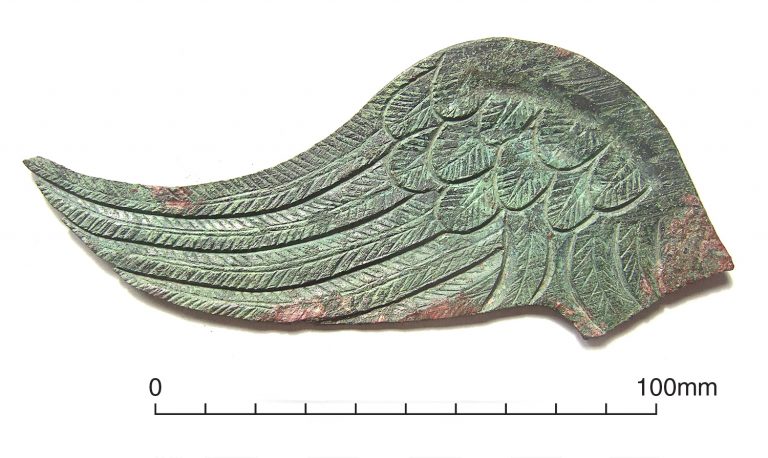 GLOUCESTER, ENGLAND—A bronze wing measuring 5.5 inches long has been
unearthed in southwestern England. At first it had been thought that the
wing, discovered in an earthen bank behind what would have been the
Roman city wall, was part of an eagle statue. But Martin Henig of Oxford
University has concluded that the wing was actually part of a Roman
statuette of Victoria, the goddess of victory. “It would be nice to
think a retired Roman soldier, spending his retirement years in
Gloucester, had a nice statuette to Victory as thanks for making it
through the Roman invasion of Britain in one piece,” Neil Holbrook of
Cotswold Archaeology said in a BBC News report.
GLOUCESTER, ENGLAND—A bronze wing measuring 5.5 inches long has been
unearthed in southwestern England. At first it had been thought that the
wing, discovered in an earthen bank behind what would have been the
Roman city wall, was part of an eagle statue. But Martin Henig of Oxford
University has concluded that the wing was actually part of a Roman
statuette of Victoria, the goddess of victory. “It would be nice to
think a retired Roman soldier, spending his retirement years in
Gloucester, had a nice statuette to Victory as thanks for making it
through the Roman invasion of Britain in one piece,” Neil Holbrook of
Cotswold Archaeology said in a BBC News report.Solstice Alignments Spotted in Washington, D.C., Garden
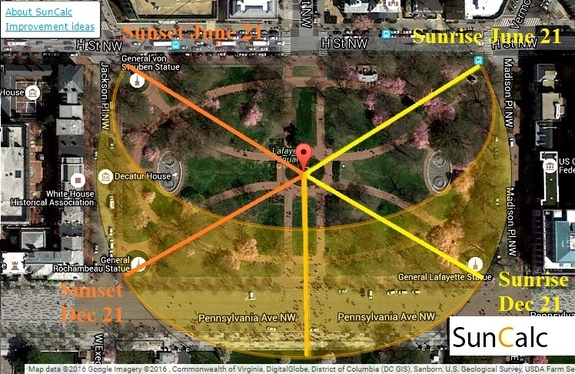 TURIN, ITALY—The statues and walkways in a symmetrical
nineteenth-century garden in Washington D.C. are aligned to the rising
and setting sun on the summer and winter solstices, according to
physicist Amelia Sparavigna of Politecnico di Torino. Live Science reports
that, using satellite imagery and astronomical software, Sparavigna
found that the solstice sun aligns with the statue of President Andrew
Jackson that stands in the center of the Lafayette Square garden. Four
walkways radiate out from this statue. Standing near the statue of
Andrew Jackson, it would appear that on the summer solstice, the sun
rises at the northeast end of one path, and sets at the northwest end of
the opposite path. On the winter solstice, the sun would appear to rise
at the southeast end of another path and set at the southwest end of
its opposite. Sparavigna says it is unclear why designer Andrew Jackson
Downing aligned the ends of the walkways to the solstice sun.
TURIN, ITALY—The statues and walkways in a symmetrical
nineteenth-century garden in Washington D.C. are aligned to the rising
and setting sun on the summer and winter solstices, according to
physicist Amelia Sparavigna of Politecnico di Torino. Live Science reports
that, using satellite imagery and astronomical software, Sparavigna
found that the solstice sun aligns with the statue of President Andrew
Jackson that stands in the center of the Lafayette Square garden. Four
walkways radiate out from this statue. Standing near the statue of
Andrew Jackson, it would appear that on the summer solstice, the sun
rises at the northeast end of one path, and sets at the northwest end of
the opposite path. On the winter solstice, the sun would appear to rise
at the southeast end of another path and set at the southwest end of
its opposite. Sparavigna says it is unclear why designer Andrew Jackson
Downing aligned the ends of the walkways to the solstice sun.Scientists Say “Lost City” Formed by Natural Phenomenon
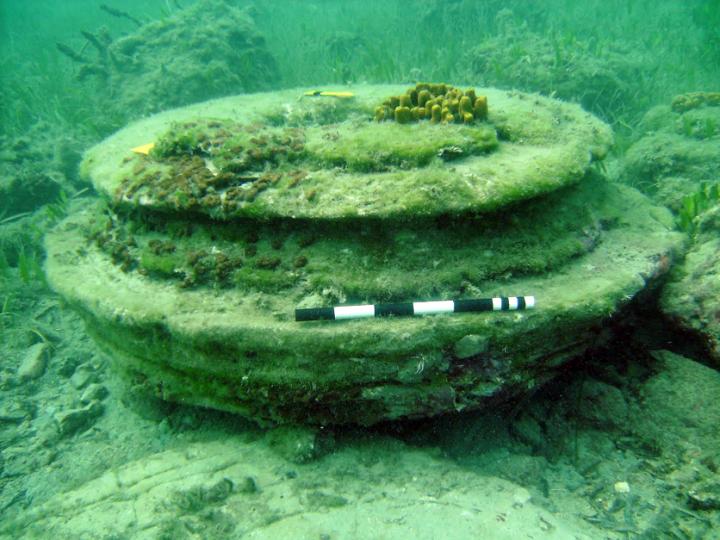 NORWICH, ENGLAND—Scientists from the University of Athens and the
University of East Anglia say that what looked like the paved floors,
courtyards, and colonnades of a lost city in shallow waters off the
coast of the Greek island Zakynthos were actually created by a natural
geological phenomenon up to five million years ago. According to a
report in Tech Times,
Julian Andrews of the University of East Anglia noticed that there
wasn’t any pottery or other signs of human activity around the supposed
ruins, which were discovered by recreational divers. The researchers
took a closer look at the mineral content and texture of the stones with
X-rays, microscopy, and stable isotope techniques. They think the
column-shaped concretions are the result of mineralization at
hydrocarbon seeps along a fault under the seabed. Microbes in the
seafloor sediments used the methane and other gases from the fault as
fuel, changing the chemistry of the sediment and forming the
concretions. Erosion eventually exposed and shaped the concretions.
“This kind of phenomenon is quite rare in shallow waters,” Andrews said.
“Most similar discoveries tend to be many hundreds and often thousands
of meters deep underwater.”
NORWICH, ENGLAND—Scientists from the University of Athens and the
University of East Anglia say that what looked like the paved floors,
courtyards, and colonnades of a lost city in shallow waters off the
coast of the Greek island Zakynthos were actually created by a natural
geological phenomenon up to five million years ago. According to a
report in Tech Times,
Julian Andrews of the University of East Anglia noticed that there
wasn’t any pottery or other signs of human activity around the supposed
ruins, which were discovered by recreational divers. The researchers
took a closer look at the mineral content and texture of the stones with
X-rays, microscopy, and stable isotope techniques. They think the
column-shaped concretions are the result of mineralization at
hydrocarbon seeps along a fault under the seabed. Microbes in the
seafloor sediments used the methane and other gases from the fault as
fuel, changing the chemistry of the sediment and forming the
concretions. Erosion eventually exposed and shaped the concretions.
“This kind of phenomenon is quite rare in shallow waters,” Andrews said.
“Most similar discoveries tend to be many hundreds and often thousands
of meters deep underwater.”New Thoughts on Dog Domestication
 OXFORD, ENGLAND—A genetic study led by Laurent Frantz of the University
of Oxford suggests that dogs may have been domesticated separately in
Asia and in Europe or the Near East. The researchers obtained DNA from
the inner ear bone of a nearly 5,000-year-old dog discovered at
Newgrange, a site on the east coast of Ireland, and sequenced its entire
genome. They then compared it to the nuclear DNA of 605 modern dogs
from around the world and calculated a genetic mutation rate. The
analysis revealed a divide between Asian dogs and European dogs between
6,400 and 14,000 years ago, and a sharp decline in the numbers of
European dogs. “We never saw this split before because we didn’t have
enough samples,” project leader and evolutionary biologist Greger Larson
said in a report in Science.
Remains of dogs found in Germany have been estimated to be more than
16,000 years old, however, suggesting that dogs could have been
domesticated in Europe before migrating Asian dogs might have replaced
them. “We don’t know if the dogs that evolved [early] in Europe were an
evolutionary dead end, but we can safely say that their genetic legacy
has mostly been erased from today’s dogs,” said Frantz.
OXFORD, ENGLAND—A genetic study led by Laurent Frantz of the University
of Oxford suggests that dogs may have been domesticated separately in
Asia and in Europe or the Near East. The researchers obtained DNA from
the inner ear bone of a nearly 5,000-year-old dog discovered at
Newgrange, a site on the east coast of Ireland, and sequenced its entire
genome. They then compared it to the nuclear DNA of 605 modern dogs
from around the world and calculated a genetic mutation rate. The
analysis revealed a divide between Asian dogs and European dogs between
6,400 and 14,000 years ago, and a sharp decline in the numbers of
European dogs. “We never saw this split before because we didn’t have
enough samples,” project leader and evolutionary biologist Greger Larson
said in a report in Science.
Remains of dogs found in Germany have been estimated to be more than
16,000 years old, however, suggesting that dogs could have been
domesticated in Europe before migrating Asian dogs might have replaced
them. “We don’t know if the dogs that evolved [early] in Europe were an
evolutionary dead end, but we can safely say that their genetic legacy
has mostly been erased from today’s dogs,” said Frantz.Maya May Have Tracked Venus From Acanceh Observatory
MÉRIDA, MEXICO—According to a report in Fox News Latino and the Mexico City newspaper Excelsior,
Beatriz Quintal Suaste of the Yucatán National Institute of
Anthropology and History says that an observatory at the Early Classic
Maya site of Acanceh may have helped priest-astronomers track the
movement of the planet Venus. The third-brightest object in the sky
after the sun and the moon, Venus is thought to have been represented in
Maya mythology by a god named Noh Ek. The new study suggests that the
southern edge of the observatory aligns with the northernmost position
of Venus in the night sky. Three codexes found at the site support the
idea that the ancient astronomers would have been able to track Venus’s
584-day cycle through the sky from the observatory.
Thursday, 23 June 2016
Kolkata: Discovery of predator fish that resembles an alligator concerns experts

Experts are concerned about the discovery of a predatory fish that
can grow up to eight feet from Subhas Sarovar in Kolkata’s eastern
fringe of Beliaghata as it can destroy local ecosystem and biodiversity.
A local angler, Shibu Mondol, caught a 3.5-feet long Alligator Gar – a
fish that resembles an alligator with long sharp teeth and equally
predatory instincts and sometimes known to attack humans – two months
ago.
Biodiversity experts, ecologists and anglers say the fish could kill
almost every other fish in the lake. The prehistoric relatives of this
mega fish inhabited many parts of the world, but today gars live only in
North and Central America. Of the seven known species, the Alligator
Gar is the largest.
“It is a highly carnivorous fish. It not only kills other fishes but
there are reports of it attacking humans too. The fish’s egg is also
poisonous. It has no natural enemies and hence can become invasive in no
time destroying the local ecosystem and biodiversity,” Mathe Rajeev
Mathew, expert member of the National Biodiversity Authority and the
Telangana State Biodiversity Board, said.
Alligator Gar has already become a nuisance in Telangana and Andhra
Pradesh and reports of the fish spreading fast and becoming invasive in
water bodies of Tamil Nadu are also pouring in. In 2015, an Alligator
Gar was caught from a well in Dadar in Mumbai.
A group of experts has been called in to tackle the menace.
“This is the first time that this species has been caught in the
city. We would like to send a team and collect the specimen. We would
also try to explore the lake to check if their population has
proliferated and how big is the threat,” KC Gopi, a fish expert of the
Zoological Survey of India, said.
Experts say they are usually smuggled into the country to be reared
in aquariums. But when the fish starts gaining size and kills other
fish, owners often release them in the local water bodies.
“We have had a similar experience with another aquarium fish called
the Crocodile fish while working in East Kolkata Wetlands. They are
bought by aquarium keepers and then released into wild when they grow
big. Crocodile fish are now found in almost every pond and lake in
Kolkata and are destroying the local biodiversity,” Dipayan Dey, who
heads the city based NGO South Asian Forum for Environment, said.
Mondol – the person who caught the fish - gave a scary account of how
he caught the fish as it tried to attack him and snap his finger.
Mondol is a member of the West Bengal Angler’s Association and fishes
regularly in Subhas Sarovar.
“Unlike a Rohu or Katla fish, which usually tries to drag the rope
deep into the pond after it is hooked, this fish was lying idle in the
water like a tortoise. When I started pulling it out of the water, I was
shocked to see the alligator-like snout. I screamed and local residents
soon rushed to the spot. The fish after being pulled out not only made a
dart to bite me but also killed a Katla fish which I caught earlier,”
Mondol said.
The Alligator Gar that Mondol caught weighed more than five kilos.
One of Mondol’s friends killed the fish and ate its meat that tasted
sour. Mondol, however, managed to retain the skin and head and is drying
to preserve it.
“We couldn’t cut the fish with a knife. It was so hard that it had to be hacked with an axe,” Mondol said.
Tuesday, 21 June 2016
World War I–Era Training Camp Excavated in Ohio
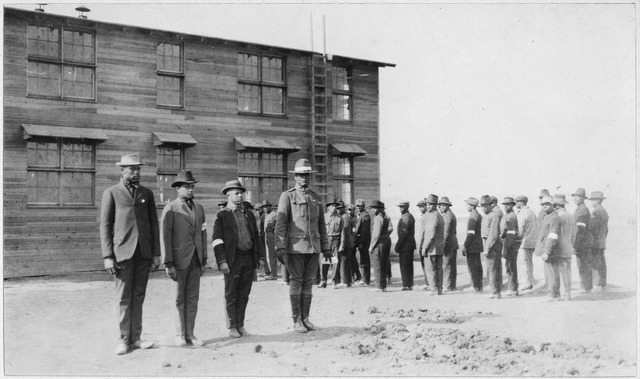 CHILLICOTHE, OHIO—The Chillicothe Gazette
reports that archaeologist Andy Sewell, members of the Ohio History
Connection, and additional volunteers are investigating Camp Sherman, a
large World War I–era training site for the Ohio Army National Guard,
ahead of the construction of a power distribution center. The team has
uncovered sewer pipes and the foundations of several buildings,
including one they think might have been a fire station. “Surprises have
been finding parts of buildings that don’t match the maps,” Sewell
said. “Mainly, the buildings are where they are supposed to be, but
there’s a mess hall, for instance, that’s further to the west than it
shows on the map, and it kind of matches up with some of the photos that
show it in line with another mess hall,” he said. Footprints in the
bakery’s concrete could also reflect how quickly the camp was
constructed. Charred pages from a ledger, a broken bottle, the base of a
toilet, food waste, and burned soil where the bakery ovens may have
been located have also been found.
CHILLICOTHE, OHIO—The Chillicothe Gazette
reports that archaeologist Andy Sewell, members of the Ohio History
Connection, and additional volunteers are investigating Camp Sherman, a
large World War I–era training site for the Ohio Army National Guard,
ahead of the construction of a power distribution center. The team has
uncovered sewer pipes and the foundations of several buildings,
including one they think might have been a fire station. “Surprises have
been finding parts of buildings that don’t match the maps,” Sewell
said. “Mainly, the buildings are where they are supposed to be, but
there’s a mess hall, for instance, that’s further to the west than it
shows on the map, and it kind of matches up with some of the photos that
show it in line with another mess hall,” he said. Footprints in the
bakery’s concrete could also reflect how quickly the camp was
constructed. Charred pages from a ledger, a broken bottle, the base of a
toilet, food waste, and burned soil where the bakery ovens may have
been located have also been found.Monday, 20 June 2016
Blade of Ancient Egyptian Dagger Analyzed
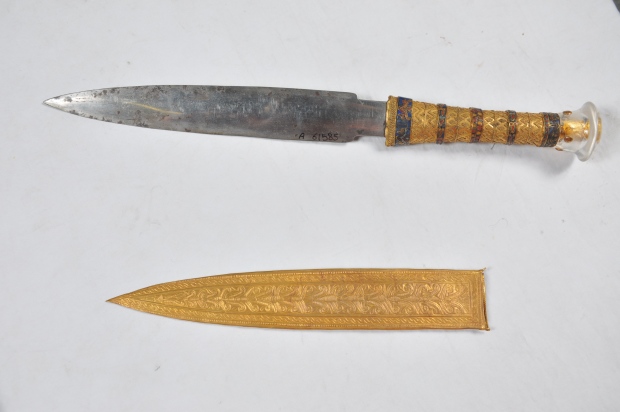
MILAN, ITALY—Daniela Comelli of the Polytechnic University of Milan and
her team conducted an analysis of the dagger found in the wrappings of
Tutankhamun’s mummy by Howard Carter in 1925. The dagger, which dates to
the fourteenth century B.C., has a gold handle, a rock crystal pommel, a
gold sheath, and an iron blade. But the ancient Egyptians are thought
to have developed iron smelting much later, in the eighth century B.C.
“The problem is iron working is related to its high melting point,”
Comelli said in an Associated Press
report. “Because of it, early smiths couldn’t heat ore enough to
extract iron and couldn’t forge the iron into weapons.” Using a
technique called X-ray fluorescence, Comelli found that Tutankhamun’s
metal blade contains ten percent nickel and 0.6 percent cobalt, a
composition that is similar to that of known metallic meteorites. The
analysis suggests that the dagger could have been hammered from rare
meteoritic iron, which is thought to have been considered more valuable
than gold.
Texts From the Early Years of Roman Rule Found in London
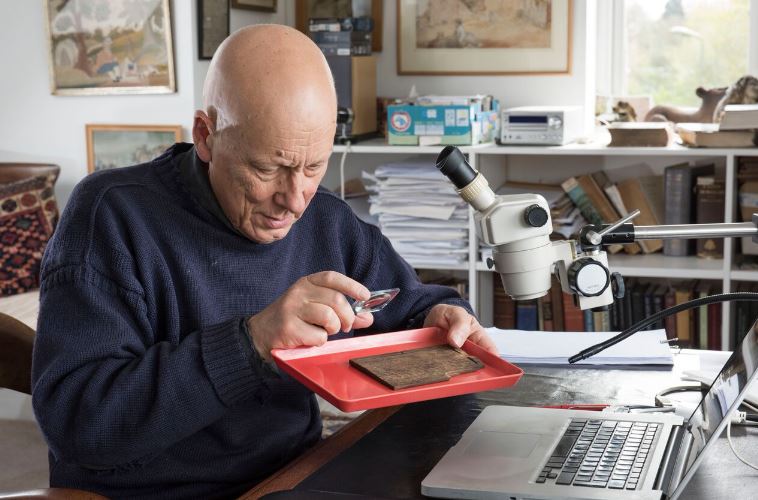 LONDON, ENGLAND—Excavations at the site of the new European Bloomberg
headquarters have yielded 405 Roman writing tablets, 87 of which have
been deciphered. According to a report in BBC News,
this more than quadruples the number of known Roman writing tablets
recovered in London. Romans would have used styluses to write on a layer
of blackened beeswax covering such wooden tablets. The wax did not
survive on these tablets, but some of the etchings went through the wax
to mark the wood, which was preserved for nearly 2,000 years in the mud
of the buried Walbrook River. Roger Tomlin, an expert in cursive Latin,
deciphered and interpreted the writings with the help of digital
photographic methods. The texts include the earliest-known reference to
London, an alphabet thought to have been written as practice or to
demonstrate literacy, and a financial document dated January 8, A.D. 57.
Researchers from the Museum of London Archaeology say it is the
earliest intrinsically dated document to have been found in the United
Kingdom.
LONDON, ENGLAND—Excavations at the site of the new European Bloomberg
headquarters have yielded 405 Roman writing tablets, 87 of which have
been deciphered. According to a report in BBC News,
this more than quadruples the number of known Roman writing tablets
recovered in London. Romans would have used styluses to write on a layer
of blackened beeswax covering such wooden tablets. The wax did not
survive on these tablets, but some of the etchings went through the wax
to mark the wood, which was preserved for nearly 2,000 years in the mud
of the buried Walbrook River. Roger Tomlin, an expert in cursive Latin,
deciphered and interpreted the writings with the help of digital
photographic methods. The texts include the earliest-known reference to
London, an alphabet thought to have been written as practice or to
demonstrate literacy, and a financial document dated January 8, A.D. 57.
Researchers from the Museum of London Archaeology say it is the
earliest intrinsically dated document to have been found in the United
Kingdom.
Subscribe to:
Posts (Atom)