Showing posts with label GENUS. Show all posts

Sunday, 15 May 2016

Chubutherium


Kingdom: Animalia
Phylum: Chordata
Class: Mammalia
Order: Xenarthra
Family: Mylodontidae
Genus: Chubutherium
Species: S. leptocephalum
               S. parodii
Conservation Status: Extinct
Temporal Range: Oligocene - Mid Miocene

Chubutherium ferelloii is an extinct species of ground sloth. They first appeared in the Oligocene and died out during the Middle Miocene. It is related to the Pleistocene genus, Scelidotherium. Only a few specimens have been found in Patagonia.

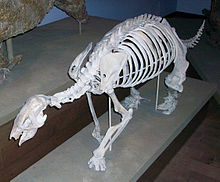
Scelidotherium

Scelidotherium leptocephalum side.jpg

Kingdom: Animalia
Phylum: Chordata
Class: Mammalia
Order: Xenarthra
Family: Mylodontidae
Genus: Scelidotherium
Species: S. leptocephalum
               S. parodii 

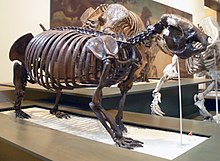
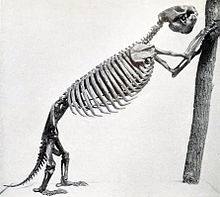
Scelidotherium is an extinct genus of ground sloth of the family Mylodontidae, endemic to South America during the middle Pleistocene epoch. It lived from 780,000 - 11,000 years ago. They existed for approximately 0.67 million years.
It is characterized by an elongated, superficially anteater-like head. It is known almost exclusively from Argentina, but its distribution may have extended into Paraguay and Uruguay.
The meaning of their name is femur Beast.
They were 3.6 ft tall and about 3000 kgs.

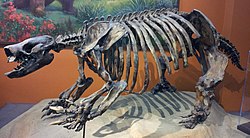
Paramylodon

San Diego Paramylodon.jpg

Kingdom: Animalia
Phylum: Chordata
Class: Mammalia
Order: Pilosa
Family: Mylodontidae
Genus: Paramylodon
Species: P. harlani
Temporal Range: Late Pliocene to Pleistocene (4.9 ma - 11,000 years ago)

It is an extinct genus of ground sloth of the family Mylodontidae endemic to North America during the Pliocene through Pleistocene epochs.
Paramylodon was about 9.8 ft in height and weighted as much as 1000 kg. It is known from North America deposits, including in Mexico and the United States and as far south as Guatemala. Currently there is just one recognized species, P. harlani. 
Recently a Paramylodon specimen was identified from the Tarkio Vallet site in Lowa association with Megalonyx. This is probably the first time these species have been found in close association. These two species have since been uncovered at  the Fairmead Landfill Site and Irvington Site in California.

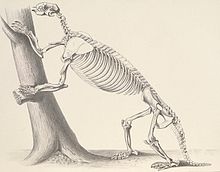
Mylodon


Kingdom: Animalia
Phylum: Chordata
Class: Mammalia
Order: Pilosa
Family: Mylodontidae
Genus: Mylodon
Species: M. darwini
Temporal Range: Pleistocene to Holocene

It is a extinct genus of ground sloth that lived in the region South America until roughly 10,000 years ago. Exactly the fossil remains found in Argentina and Chile.
Mylodon's close relatives include the ground sloths of the genera has often been confused with Glossotherium and Paramylodon. Scientists often confused Mylodon with Glossotherium. 
Mylodon weighed about 2,500 kg and stood up to 10 ft when raised up on its hind legs. It had very thick hide and had osteoderms within its skin for added armor. Because of this armor and its long and sharp claws, it is unlikely that the Mylodon had any natural enemies other than humans, who would have still difficult to pierce with stone projectile points.
Mylodon has been traditionally considered a grazer in open areas, which is theorized based on its paleoenvironment as well as from the vegetation found in fossilized dung. However new study suggests that they  had been a mixed or selective-feeder instead and the paleoenvironment of the formation where the animal was found indicates a wide variety of vegetation to be selected from. 
The Mylodon had a wide range of climate and environment tolerance. It was probably capable of inhabiting arid to semiarid and cold climates, humid and warm climates and cooler and montane climates.

Saturday, 14 May 2016

Lestodon

Lestodon armatus Ghedo.JPG

Kingdom: Animalia
Phylum: Chordata
Class: Mammalia
Order: Pilosa
Family: Mylodontidae
Genus: Lestodon
Species: L. armatus
Temporal Range: Pleistocene

It is an extinct genus of megafaunal ground sloth from South America during the Pleistocene period. Its fossil
remains have been found in Argentina, Paraguay, Uruguay and Bolivia. 4.6 (15ft) from snout to tail tip, it is estimated to have weighted about 4 tons. It was a herbivore and primarily fed on the grasses on the South American Plains and is thought to perhaps have used its semi-bipedal stance to obtain foliage from trees. The genus name Lestodon derives from the Greek for robber tooth.
Lestodon had a large, blunt and square mandible well adapted for foliage consumption. Its muzzle and dentition show significant adaption to this diet. The shape of the muzzle aided the ground sloth in the grazing necessary to sustain the metabolic activity of its large body, square,flat muzzles are associated with bulk feeders while pointed snouts are adaptive features of precision eaters. To sustain its coloric needs with plant matter, the sloth would have needed to be able to consume a high quantity of food with little precision. The species would dig its food, and would have accidentally ingested a large amount of grinity dirt and soil particulate. This gives them a large crown height, called hypsodonty that is unsuitable for strong bite forces. While the mandibular muscles would have been well developed to support the allometrically positive jaw of Lestodon, they would have also been extremely weak.
Researchers working at the Arroyo del Vizcaino site near Sauce, Uruguay, found evidence suggesting that Lestodon was hunted by humans about 30,000 years ago. This was discovered through the analysis of Lestodon bones. Deep slash markings on some of them were discovered the use of human stone tools.

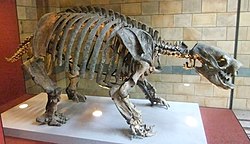
Glossotherium

Skeleton, Natural History Museum, London - DSCF0385.JPG

Kingdom: Animalia
Phylum: Chordata
Class: Mammalia
Order: Xenarthra
Family: Mylodontidae
Genus: Glossotherium
Species: G. robustum
               G. chapadmalense
Temporal Range: Late Pliocene to Early Holocene (2.5 - 0.010 ma)

Its literal meaning is the Tongue Beast. It was a genus of ground sloth which was heavily built animal with a length of about 13 ft snout to tail-tip and a weight estimated at 1000 kg. They could potentially assume a slight bipedal stance.
They are generally wider and more robust with a dignostic increased amount of lateral flare at the predental spout. 
G. robustum was endemic to South America and weighted about 1500 kg. Pleistocene records indicate that it was widely distributed between 20 degree south to 40 degree south with a range spanning across Argentina, Chile, Uruguay, and Paraguay.
Sloths have ever-growing adult dentition. They lack deciduous dentition and have a reduction in tooth number. Sloth teeth also lack the enamel and cuspation pattern generally present in other mammals. Their tooth forms are oval, sub-rectangular or elongate irregular ovoid. cheek teeth in Glossotherium are larger, have more complex shapes and retain more of the cementum layer around all sides of each tooth than the shasta ground sloth and tree sloths.


Their diet is still unclear. However based on the dental evidence, it was likely more suited to grazing, though it was also probably less efficient at ingesting grasses since its dental apparatus was more suited to shearing which would have been too ineffective at processing plant materials down to an ingestible size to obtain adequate nutritive value. They have a very slow rate of passage of food through the gut. They could probably survive better on foods of lower nutritional value than other sloths could. They likely ate grasses, but also probably they ate a variety of foliage as well and would be better considered a browser-grazer than simple grazer.
They use the same way what the elephants do to communicate. sloths may have used low frequency sounds in melting calls or other social interactions of for long-range sound sensing as in predator-prey interactions or weather forecasting. Another possible explanation for hearing in low frequencies may be due to forssorial habits: low hearing frequencies coupled with a short interaural distance suggest that Glossotherium probably had very poor sound localization.This indicates evidence of an underground lifestyle since loss of high frequency hearing is common to fossorial mammals. Their huge nostrils were likely effective for sound emission with expanded nares possibly related to emission of low frequency sounds up to 600 Hz.
Due to its size and strength, Glossotherium would have had few natural enimies apart from Smilodon. It is believed to have died out in the Pleistocene (1.8 - 12,000 years ago). The most recent reported date is about 8700 years ago.
They have been found in South America and Mexico. It is closely related to Paramylodon of North America.Earliest Glossotherium specimens are known from the Pliocene of South America and are represented by the species, G. chapadmalense. All speciemens of Pleistocene age are typically lumped into G. robustum and a few other quentionalbe species. Further research is needed at the species level.

Wednesday, 11 May 2016

Pronothrotherium

Pronothrotherium typicum.jpg

Kingdom: Animalia
Phylum: Chordata
Class: Mammalia
Order: Xenarthra
Family: Nothrotheriidae
Genus: Pronothrotherium
Species: P. typicum
Temporal Range: Miocene

It is an extinct genus of ground sloth of South America. They were from the Miocene Epoch. They may be familiar with the Marine life.

Nothrotherium

Nothrotherium.JPG

Kingdom: Animalia
Phylum: Chordata
Class: Mammalia
Order: Xenarthra
Genus: Nothrotherium
Species: N. maquinense Lund
               N. escrivanense
 It is an extinct genus of medium-sized ground sloth from South America and Mexico. It differs from Nothrotheriops in smaller size and differences in skull and hind leg bones, but genera can be traced back to Hapolops, the genus which both evolved from in different ecoloogical conditions. These browsing ground sloths consumed roots, stems, seeds and leaves of various desert plants, such as the yucca and agave.

Saturday, 9 April 2016

Hapalops


Kingdom: Animalia
Phylum: Chordata
Class: Mammalia
Order: Xenarthra
Family: Megatheriidae
Species: H. indifferens
               H. longiceps
               H. latus
               H. cadens
               H. congermanus
               H. gallaicus
Conservation Status: Extinct
Temporal Range: Late Oligocene - Miocene

Hapalops is extinct genus of ground sloth from the late Oligocene of South America. Though related to the giant Megatherium, Hapalops was much smaller, measuring about 1 meter in length. Like most extinct sloths it is categorized as a ground sloth, but it is believed that the smaller size of Hapalops allowed it to engage in some climbing behaviors.


It had a robust body, short skull and long limbs with large, curved claws. When it did visit the ground the animal probably walked on the knuckles of its forelimbs, like gorilla. Hapalops had very few teeth with no incisors, the mandible included only four pairs of teeth.

Sunday, 3 April 2016

Choloepus


Kingdom: Animalia
Phylum: Chordata
Class: Mammalia
Order: Pilosa
Genus: Choloepus
Species: C. didactylus
               C. hoffmanni
Temporal Range: Late Miocene to Recent

Choloepus is a genus of living sloth which lived in Central and South America, within the family Megalonychidae consisting of two-toed sloths. This is the only surviving genus of the family Megalonychidae which has two species, Linnaeus's two-toed sloth and Hoffmann's two-toed sloth.

Relation to the three-toed sloth

The relationship between the two-toed and three-toed sloth is not close. According to study it is confirmed that the two genera are not closely related and each adopted its arboreal lifestyle independently. It is unclear from which (if any) ground dwelling sloth the three-toed sloths evolved; the two-toed sloths appear to nest phylogenetically within one of the divisions of Caribbean megalonychids, and thus probably either descended from them or are part of a clade that invaded the Caribbean multiple times. Though data has been collected on over 33 different species of sloths just by analyzing bone structures, many of the relationships between clades on a phylogenetic tree are unknown. Both types tend to occupy the same forests; in  most areas, a particular species of three-toed sloth and a single species of the larger two-toed type will jointly predominate.

Each genus of sloth has a common ancestor, but what that ancestor was, when it existed, and many of its traits remain virtually unknown. There is relatively little evidence to support the hypothesis of diphyly and only a small amount of data to study overall.In fact, most of the evidence of support the hypothesis of diphyly  is still heavily based on the same trait that cause the hypothesis to be suggested; the structure of the inner ear.

One of the largest problems that exists when attempting to identify clades of modern tree sloths is the issue of missing links between surviving, living species and their unidentified common ancestors. There are several families of extinct sloths, about which very little is known. The missing information causes large holes in phylogenetic trees and makes tracing paths of evolution a daunting task. As a result, there are many versions of the phylogenetic tree that would describe the evolution and relationship between sloths, most of which conclude that convergent evolution is the likely mechanism that resulted in today's genera of tree sloths. Despite a couple of discrepancies in DNA sequencing, it is largely accepted that extant tree sloth species of genera Choloepus and Bradypus do not share a recent common ancestor, making them diphyletic to one another and indicating similarities through convergent evolution.. This means that the two extant genera evolved analogous traits, such as locomotion methods, size, habitat and many other traits independently. from one another as opposed to from their last common ancestor.

If the theory of convergent evolution between the two species were accepted  as true, that would make sloths one of the most striking examples of convergent evolution known among mammals. In order to further support this theory, there would need to be more information and data gathered about intermediate species between the extant species and the common ancestor, which is estimated to have gone extinct over 30 million years ago.

A study of retrovirus and m-DNA suggests that C. didactylus and C. hoffmanni diverged six to seven million years ago. Furthermore, based on cytochrome c oxidase subunit I sequence, a similar  divergence date (~7mya) between the two populations of C. hoffmanni separated by the Andes has been reported.

Characteristics

The name two-toed sloth erroneously describe the number of toes. They have two fingers in their hands (in the thoracic limbs) and three toes in their feet (in the pelvic limbs). The name two-toed sloth is misleading, although widely used. The name was intended to describe specific anatomical differences between members of the genus Choloepus and Bradypus. However to accurately describe these differences, the correct name should be two fingered sloth (Choloepus spp) as the differences occur in the hands and not in the feet. They are also larger than tree-toed sloths, having a body length of 58 to 70 cm and weighing 4 to 8 kg. other distinguishing features include a more prominent snout, longer fur, and the absence of a tail.

two-toed sloths have a reduced, ever growing dentition with neither incisors nor true canines, which overall lacks homology with the dental formula of other mammals. Their first tooth is very canine-like in shape and is referred to as a caninoform. It is separated from the other teeth or molariforms by a diastema. The molariforms are used specifically for grinding and are mortar and pestle-like in appearance and function. Thus, they can grind food for easier digestibility, which takes the majority of their energy.They dental formula of two-toed sloths is: 4/5 (unau)

Two-toed sloths are unusual among mammals in possessing as few as five cervical verrtebrae, which may be due to mutations in the homeotic genes. All otehr mammals have seven cervical vertebrae. Other than the  three-toed sloth and the manatee.

Feeding

They eat primarily leaves, but also shoots, fruits, nuts, berries, bark, some native flowers and even some small rodents. When they can not find food they have been known to eat the algae that grow on their fur for nutrients. They have large stomachs with multiple chambers, which help to ferment the large amount of plant matter they eat. Food can take up to a month to digest due to their slow metabolism. Depending on when in the excretion cycle a sloth is weighed, urine and feces may account for up to 30% of the animal's body weight which averages about 6 kg. They get their water from juicy plants.

Behaviour

The two-toed sloths most of their lives hanging upside down from trees. They cannot walk, so they pull hand-over-hand to move around which is at an extreme slow rate. Being predominantly nocturnal, their fur which grows greenish algae to blend in, is their main source of protection. Their body temperatures depend at least partially on the ambient temperature; they cannot shiver to keep warm, as other mammals do, because of their unusually low metabolic rates and reduced musculature. The-toed sloths also differ from three-toed sloths in their climbing behavior, preferring to descend head first.

Life Cycle

Two-toed sloths have a gestation period of six months to a year, depending on the exact species. The mother gives births to a single young while hanging upside down. The young are born with claws and are weaned after about a month, although they will remain with the mother for several more months and do not reach sexual maturity until the age of three years, in the case of females or four to five years, in the case of males.

Saturday, 2 April 2016

Neocnus

Synocnus comes.jpg

Kingdom: Animalia
Phylum: Chordata
Class: Mamallia
Order: Pilosa
Family: Megalonychidae
Genus: Neocnus
Species: N. gliriformis
               N. major
               N. comes
               N. dousman
               N. toupiti
Conservation Status: Extinct
Temporal Range: Pleistocene

 Neocnus is an extinct genus of ground sloth, whose species ranged across Cuba and Hispaniola. Neocnus would have resembled a typical megalonychid ground sloth, though much smaller, with a longer tail and broad trunk, as well as lissome limbs and long claws. This sloth was known for having caudal vertebrae that were broad, a trait shared with other ground sloths, indicating that this animal like the tamandua of today, likely used its tail to stand  upright. The caniniform teeth of the Neocnus were large and triangular, and its skull was deep and large. 

The fossils of this sloth were found in Haitian cave deposits. They have been dated to as recently as 4391 BP, calibrated to 5000 BP. It is theorized that this sloth, in common with other Antillean sloths was killed off by humans seeking its pelt and meat. Currently, this species of sloth is being studied by evolutionary historians. Neocnus is suspected of having been semi-arboreal.

Megalocnus


Megalocnus rodens.JPG

Kingdom: Animalia
Phylum: Chordata
Class: Mammalia
Order: Pilosa
Family: Megalonychidae
Genus: Megalocnus
Species: M. redens
               M. zile
Conservation Status: Extinct
Temporal Range: Late Pleistocene to Holocene


The ground sloths of the extinct genus Megalocnus were among the largest of the Caribbean ground sloths, with individuals estimated to have weighted up to 90 kg when alive. Two species are known, M. rodens of Cuba and M. zile of Hispaniola. Megalocnus means great sloth. According to the fossil reports M. redens indicate survival well into the Holocene.

Imagocnus

 
Kingdom: Animalia
Phylum: Chordata
Class: Mammalia
Order: Xenarthra
Family: Megalonychidae
Genus: Imagocnus
Species: I. zazae
 Temporal Range: Early Miocene 

Imagocnus is an extinct genus of ground sloth from the early Miocene of Cuba.This sloth resided in the Antilles and showed a range of body size. Its relationships to other Antilean sloths are not immediately clear, though the genera Megalocnus and Parcnus other ground sloths are its most likely relatives. Not much details is known about this genus of sloth due to lack of fossil evidence. Though it is believed that this genus of sloth did not lived for a long time period for some unknown reason.

Thursday, 31 March 2016

Habanocnus


Kingdom: Animalia
Phylum: Chordata
Class: Mammalia
Order: Xenarthra
Family: Megalonychidae
Genus: Habanocnus
Species: H. hoffstetteri
               H. paulacounto

Habanocnus is an extinct genus of ground sloth. It is also known as the Havana Sloth. It is  indigenous to Late Pleistocene Cuba. There is not much significant excavation of these spices with what we can get some identification. What we gather, we can only say that Acratocnus and Habanocnus are taxonomic synonyms. There is not much identificational difference between these to genus.

Wednesday, 30 March 2016

Acratocnus

acratocnus

Kingdom: Animalia
Phylum: Chordata
Class: Mammalia
Order: Pilosa
Genus: Acratocnus
Species: A. odontrigonus
              A. antillensis
              A. ye

Temporal Range: 2.5 mya - 5000 BP (Pleistocene to Holocene)

Acratocnus is an extinct genus of ground sloth found in Cuba, Hispaniola and Puerto Rico. It is a member of the family Megalonychidae, whose sole surviving genus is Choloepus (the two toed tree sloth)

Habanocnus.JPG 

HABITAT

The species of Acratocnus were found on the islands of Puerto Rico, Cuba and Hispaniola, where they inhabitat the montane forests of the highlands. The Puerto Rican ground sloth, Acratocnus odontrigonus is known from several poorly documented cave excavations in northwestern Puerto Rico. The various species are regarded as being semi-arboreal because of their small size and their large hooked claws.

SIZE

The various species of Acratocnus ranged in different weights. their weight varied from 22kg to 70 kg.This indicates that they are much larger than the living tree sloths as those are not more than 15 kg.


EXTINCTION

As with many sloth fossils, these species of sloth have not been radio-metrically dated. It is suggested that the Puerto Rican and Hispaniolan Acratocnus species survived into the late Pleistocene but disappeared by the mid-Holocene. According to the latest survival reports it is confirmed that there is no evidence of any kind of ground sloth in Cuba after 5000 BP. The causes of their extinction may have been climate changes or more likely human hunting or any kind of plague.

Saturday, 26 March 2016

Megalonyx


Kingdom: Animalia
Phylum: Chordata
Order: Pilosa
Family: Megalonychidae
Genus: Megalonyx
Species: M. matthisi
               M. wheatieyi
               M. leptostomus
               M. jeffersonii

Conservation Status: Extinct
Temporal Range: Miocene to Pleistocene 

Megalonyx is an extinct genus of giant ground sloths of the family Megalonychidae endemic to North America from the Hemphillian of the Late Miocene through to the Rancholabrean of the Pleistocene, living from around 10. 3 Million years ago to 11,000 years ago, existing for approximately 10.289 million years.

DESCRIPTION

Megalonyx certainly does not look like a sloth, it was a large, heavily built animal about 9.8 feet (3m) long. Its maximum weight is estimated at 1000 kg. This is medium-sized among the giant ground sloths. It is of the size of an American Bison. Like other ground sloths it had a blunt snout, massive jaw, and large peg-like teeth.

 HIND LEGS

It was not like the usual sloths what we have seen in the jungles of South America, it was built for living on the ground. Their hind was built like human feet, i.e. Megalonyx walked with heel, foot and toe bones all on the ground just what we do. This provided good surface area for carrying weight and better balance when the stood up. This is called 'Plantigrade' by the biologists. This provided good surface area for carrying weight and better balance when Megalonyx stood up. And Megalonyx probably spend a lot of time standing in order to eat. To give this giant ground sloth added stability and to ease the stress on its massive hind legs.

 TAIL

Except their massive legs the have a thick, muscular tail which is very rare for the land mammals. Its massive hips gave ample area for strong muscles, while Megalonyx spent time ripping down and feasting on soft leaves and fruit from the trees.

ARM

Bending down those huge branches to reach its mouth was the job of the Megalonyx's powerful arms. The arm and shoulder bones are large and have wide wings and large knobs where big muscles attached. Each of the three fingers on the hand was equipped with large, powerful claws upto 8 inches or 20 cm long. Unlike the claws of the modern lion these giant claws were mostly used to grasp and tear up branches and leaves. However, they also made for a very effective defense against the predators. One swipe of the arm of the Megalonyx may have been more powerful than a grizzly bear.

TEETH

One of the most peculiar anatomical  feature of sloths is their teeth, which lack the hard enamel found in the humans and nearly all other mammals. Instead, sloths possess simple peg-like molar (back) teeth made primarily of the material dentin. Dentin is much softer than enamel and wears out faster. The sloths teeth never stop growing. Because of this, Megalonyx could keep on eating even if a tooth was damaged, since the damaged part would wear out and be replaced by healthy dentin over time. Inlike nearly all other mammals, Megalonyx never had to worry about a chipped tooth.

TAXONOMY

The generic name Megalonyx was proposed by future U.S. President Thomas Jefferson in 1797, based on fossil specimens of what later came to be called Megalonyx jeffersonii that he had received from western Virginia. His presentation to the American Philosophical Society that year is often credited as the beginning of vertebrate paleontology  in North America. However, Jefferson's name has no validity in zoological nomenclature, and Megalonyx was first formally named by Richard Harian in 1825.


EVOLUTION

Megalonyx evolved from ancestors that island-hopped across the Central American Seaway from South America, where ground sloths arose, prior to formation of the Panamanian land bridge. Its appearance in North America thus predates the bulk of the faunal exchange between North and South America. Its immediate predecessor was Pliometanastes and its closest living relatives are the two toed sloths (Choloepus).
M. jeffersoni lived from the Illinoian Stage during the Middle Pleistocene (150,000 years BP) through to the Rancholabrean of the Late Pleistocene (11,000 BP). It belongs to the genus Megalonyx, a name proposed by Thomas Jefferson, future president of the United States, in 1797. M. jeffersoni was probably descended from M. wheatieyi, which was in turn was probably derived from M. leptostomus. This was named by Cope (1893). This species lived from Florida to Texas, north to Kansas and Nebraska, and west to New Mexico, Nevada, Oregon, and Washington. It is about half the size of M. jeffersoni.


HABITAT

Megalonyx ranged over much of North and Central America. Their remains have been found as far north as Alaska and the Yukon.

M.jeffersonii was apparently the most wide ranging giant ground sloth. Fossils are known from many Pleistocene sites in the United States, including most of the states east of the Rocky Mountains as well as along the west coast. It was the only ground sloth to range as far north as the present-day Yukon and Alaska.

The first specimen  ever found in the Colorado was discovered at the Ziegler Reservoir site near Snowmass Village. The Firelands ground sloth fossils dated between 11,727and 11,424 B.C. represents the earliest known hunting activity by Ohioan Paleoindians.

SOCIAL BEHAVIOR

Aside from the basics of the size, food choice and general mobility it is often difficult to learn details of the life habits of animals from their fossils. But recently from an ongoing excavations at Tarkio valley in southwest lowa may reveal something of the familial life of Megalonyx. An adult was found in direct association with two juveniles of different ages, suggesting that adults cared for young of different generations.

Monday, 18 May 2015

Three Toed Sloth


Scientific Classification
Kingdom:
Animalia
Phylum: Chordata
Class: Mammalia
Order: Pilosa
Suborder:
Folivora
Family: Bradypodidae
Genus: Bradypus


OVERVIEW

              The tree-toed sloths are tree living mammals, living in the Central and South America. They are the only members of the genus Bradypus and the family Bradypodidae. 

CHARACTERISTIC 

              The three-toed sloths are about the size of a small dog or a large cat. They are around 18 inches (45 cm) in length and a weight of 3.5 to 4.5 kg. They  have short tails of  2-3 inches (6-7cm), and they have three clawed toes on each limb. They are frequently referred to as three-toed sloths, but all sloths have three toes; the difference is found in the number of fingers, meaning they are now more appropriately referred to as three-fingered sloths. This idea was first implemented by Judy Avey-Arroyo, co-founder of the world's only sloth sanctuary, but is now recognized in numerous publications as the correct terminology for these animals.
               They have no incisor or canine. teeth. just a set of peg-shaped cheek teeth that are not clearly divided into premolar and molar. Three-toed sloths have nine cervical vertebrae.

BEHAVIOR 

           The are agile swimmer, They are slow in trees. The offspring cling to their mother's bellies for around nine months. They cannot walk on all four limbs, so they must use their front arms and claws to drag themselves across the rain forest floor.
          Their long, coarse fur often appears greenish, not due to pigment, but to algae growing on it. Sloths' greenish color and their sluggish habits provide an effective camouflage: hanging quietly, sloths resemble a bundle of leaves. Large curved claws help sloths to keep a strong grip on tree branches.
           They move between different trees up to four times a day, although they prefer to keep to a particular type of tree, which varies between individuals, perhaps as a means of allowing multiple sloths to occupy overlapping home ranges without competing each other. 
           They are diurnal, although they can be active any time at the day. 


Green: B. variegatus, Blue: B. tridactylus, Red: B. torquatus

LIFECYCLE

           Members of this genus tend to live around 25 to 30 years, reaching sexual maturation at three to five years of age. Three-toed sloths do not have a mating season and breed year round. Females give birth to a single young after a gestation period of around six months.
         For the first few months after giving birth, mothers remain at just one or two trees, and guide their young. At about five to seven months of age, when the young have become more independent, mothers expand their resources and leave their young in new areas. At the age of nine cubs do not need any breast milk for feeding. At this time the mother leaves her home territory to her offspring and move elsewhere. The home ranged for the mothers are larger than the those of young. After separation, only the mothers use the cacao agro forest, but both use riparian forest. Different types of trees are used by both mother and young, which indicates that this agricultural matrix provides an important habitat type for these animals. 
           Adults are solitary, and mark their territories using anal scent gland and dung middens. 
           Male three-toed sloths are attracted to females by their screams echoing throughout the canopy. Sloth copulation lasts an average of twenty-five minutes.

RELATION TO THE TWO-TOED SLOTH

          Although similar to the somewhat larger and generally faster-moving two-toed sloths, the two genera are placed in different families. the two genera are not closely related and that each adopted their arboreal lifestyles independently.  It is unclear from which taxa the three-toed sloths evolved or whether they retain their arboreality from the last common ancestor of sloths the two-toed sloths appear to nest phylogenetically within one of the divisions of ground-dwelling Caribbean megalonychids and  thus probably either descended from them or are part of a clade that invaded the Caribbean multiple times. Both types of sloths  tend to occupy the same forests; in most areas, a particular single species of three-toed sloths and a single species of the larger two-toed type will jointly predominate. Famously slow-moving, the sloth travels at an average speed of 0.24 kilometres per hour (0.15 mph).

SPECIES

Pygmy Three-Toed Sloth  (B. pygmaeus) (critically endangered species)
Maned Three-Toed Sloth (B. torquatus) (endangered species)