Showing posts with label PREHISTORY. Show all posts

Thursday, 7 July 2016

Cannibalism among late Neanderthals in Northern Europe

Grisly evidence has been uncovered by researchers that Neanderthals butchered their own kind some 40,000 years ago, opening up many possibilities regarding the way late Neanderthals dealt with their dead in this last period before they died out. 
Neanderthal bones from an excavation in Belgium have yielded evidence of intentional butchering. The findings, from the Goyet caves near Namur, are the first evidence of cannibalism among Neanderthals north of the Alps. The skeletal remains were radiocarbon-dated to an age of around 40,500 to 45,500 years. Remarkably, this group of late Neanderthals also used the bones of their kind as tools, which were used to shape other tools of stone.
Professors Hervé Bocherens and Johannes Krause of Tübingen's Senckenberg Center for Human Evolution and Palaeoenvironment, along with Cosimo Posth and Christoph Wissing, also of the University of Tübingen, took part in the investigations. A review of the finds from the Troisième caverne of Goyet combined results from various disciplines; it identified 99 previously uncertain bone fragments as Neanderthal bones. That means Goyet has yielded the greatest amount of Neanderthal remains north of the Alps.
By making a complete analysis of the mitochondrial DNA of ten Neanderthals, the researchers doubled the existing genetic data on this species of humans which died out some 30,000 years ago. They confirmed earlier studies' results, which showed relatively little genetic variation in late European Neanderthals -- in other words, that they were closely related to one another. The findings have been published in the latest Scientific Reports.
The Troisième caverne of Goyet was excavated nearly 150 years ago. Today, researchers are able to extract vast amounts of information using current methods -- such as precise digital measurement and categorization of the bones, examination of the conditions in which the bone fragments were preserved, as well as isotopic and genetic analysis.
Some Neanderthal remains from Goyet have been worked by human hands, as evidenced by cut marks, pits and notches. The researchers see this as an indication that the bodies from which they came were butchered. This appears to have been done thoroughly; the remains indicate processes of skinning, cutting up, and extraction of the bone marrow. "These indications allow us to assume that Neanderthals practised cannibalism," says Hervé Bocherens. But he adds that it is impossible to say whether the remains were butchered as part of some symbolic act, or whether the butchering was carried out simply for food. "The many remains of horses and reindeer found in Goyet were processed the same way," Bocherens says. Researchers have long debated the evidence of cannibalism among Neanderthals, which until now focused on the sites of El Sidrón and Zafarraya in Spain and two French sites, Moula-Guercy and Les Pradelles. The Troisième caverne of Goyet is the first example of this phenomenon from more northern parts of Europe.
Four bones from Goyet clearly indicate that Neanderthals used their deceased relatives' bones as tools; one thigh bone and three shinbones were used to shape stone tools. Animal bones were frequently used as knapping tools. "That Neanderthal bones were used for this purpose -- that's something we had seen at very few sites, and nowhere as frequently as in Goyet," Bocherens says.
The new findings open up many possibilities regarding the way late Neanderthals dealt with their dead in this last period before they died out. Bocherens says none of the other Neanderthal sites in the region have yielded indications that the dead were dealt with as they were in Goyet. On the contrary, they have yielded burials. Researchers say that, in addition, other northern European Neanderthal sites had a greater variety and various arsenals of stone tools. "The big differences in the behavior of these people on the one hand, and the close genetic relationship between late European Neanderthals on the other, raise many questions about the social lives and exchange between various groups," says Bocherens.

Taken from The Science Daily

Thursday, 2 June 2016

Meet Our newest Ancestors Homo Naledi

                                                    Homo Naledi
Domain : Eukarya
Kingdom : Animalia
Phylum : Chordata
Subphylum : Vertebrata
Class : Mammalia
Order : Primates
Family : Hominidae
Sub Family : Homininae
Tribe : Hominini
Subtribe : Hominina
Genus : Homo
Species : Homo Naledi

A team of Paleoanthropologists under Lee Berger went into the Rising Star Cave in Gauteng Province in South Africa in 2013 and till 2016 fossils were found there and these fossils have been proposed to represent he extinct species of the hominin Homo Naledi.


 The Rising Star Cave


The excavation team consisted six paleoanthropologists who were all female and could pass through an openeing only seven inches ( 18 cm ) wide to acess the Dinaledi chamber. Those chosen were Hannah Morris , Marina Elliot , Becca Peixotto , Alia Gurtov , Lindsay Eaves and Ellen Feuerriegel.
They have since been named the Underground Astronauts .
More than 1200 fossils were found in the Dinaledi Chamber and catalouged in November 2013 representing atleast a dozen individuals . Only 20 out of 206 bones of the human body were not found in the chamber.

As of September 2015 fossils of atleast 15 individuals , amounting to 1550 specimens , had been excavated from the cave. About 300 bone fragments were found from the surface of the Dinaledi  Chamber  and about 1250 fossil specimens  were recovered from the chamber's excavation pit . The fossils include skull ,jaws , ribs , teeth , bones of an almost complete foot , of a hand and of an inner ear. The bones of old , young and infant individuals were found .


ARTISTS IMPRESSION OF THE HOMO NALEDI


Anthropologist John D Hawkes from the University of Wisconsin Madinson who was a member of the team stated that the scientific facts are that all bones recovered are hominid except for those of an owl. There is no sign of predation and and there is no predator that  accumulates  only hominids this way and the bones were not accumulated here all at once . There is no evidence of rocks falling into the cave along with the  bones or the bones having been flown here along with water . Lee Berger and his team have suggested that the best hypothesis that these individuals were capable of ritualistic behaviour . They speculate that the placing of dead bodies in the cave was a ritualistic behaviour , a sign of symbolic thought which implies that they had intelligence and were similar to human species


The homo naledi fossils are the largest collection of fossils found of a single species of hominin in Africa and provides information about the early evolution of humans.


Picture Right - Skeletons Discovered

Sunday, 15 May 2016

Chubutherium


Kingdom: Animalia
Phylum: Chordata
Class: Mammalia
Order: Xenarthra
Family: Mylodontidae
Genus: Chubutherium
Species: S. leptocephalum
               S. parodii
Conservation Status: Extinct
Temporal Range: Oligocene - Mid Miocene

Chubutherium ferelloii is an extinct species of ground sloth. They first appeared in the Oligocene and died out during the Middle Miocene. It is related to the Pleistocene genus, Scelidotherium. Only a few specimens have been found in Patagonia.

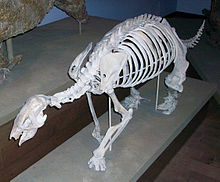
Scelidotherium

Scelidotherium leptocephalum side.jpg

Kingdom: Animalia
Phylum: Chordata
Class: Mammalia
Order: Xenarthra
Family: Mylodontidae
Genus: Scelidotherium
Species: S. leptocephalum
               S. parodii 

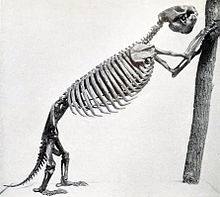
Scelidotherium is an extinct genus of ground sloth of the family Mylodontidae, endemic to South America during the middle Pleistocene epoch. It lived from 780,000 - 11,000 years ago. They existed for approximately 0.67 million years.
It is characterized by an elongated, superficially anteater-like head. It is known almost exclusively from Argentina, but its distribution may have extended into Paraguay and Uruguay.
The meaning of their name is femur Beast.
They were 3.6 ft tall and about 3000 kgs.

Paramylodon

San Diego Paramylodon.jpg

Kingdom: Animalia
Phylum: Chordata
Class: Mammalia
Order: Pilosa
Family: Mylodontidae
Genus: Paramylodon
Species: P. harlani
Temporal Range: Late Pliocene to Pleistocene (4.9 ma - 11,000 years ago)

It is an extinct genus of ground sloth of the family Mylodontidae endemic to North America during the Pliocene through Pleistocene epochs.
Paramylodon was about 9.8 ft in height and weighted as much as 1000 kg. It is known from North America deposits, including in Mexico and the United States and as far south as Guatemala. Currently there is just one recognized species, P. harlani. 
Recently a Paramylodon specimen was identified from the Tarkio Vallet site in Lowa association with Megalonyx. This is probably the first time these species have been found in close association. These two species have since been uncovered at  the Fairmead Landfill Site and Irvington Site in California.

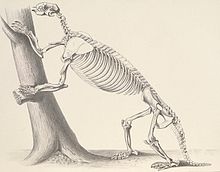
Mylodon


Kingdom: Animalia
Phylum: Chordata
Class: Mammalia
Order: Pilosa
Family: Mylodontidae
Genus: Mylodon
Species: M. darwini
Temporal Range: Pleistocene to Holocene

It is a extinct genus of ground sloth that lived in the region South America until roughly 10,000 years ago. Exactly the fossil remains found in Argentina and Chile.
Mylodon's close relatives include the ground sloths of the genera has often been confused with Glossotherium and Paramylodon. Scientists often confused Mylodon with Glossotherium. 
Mylodon weighed about 2,500 kg and stood up to 10 ft when raised up on its hind legs. It had very thick hide and had osteoderms within its skin for added armor. Because of this armor and its long and sharp claws, it is unlikely that the Mylodon had any natural enemies other than humans, who would have still difficult to pierce with stone projectile points.
Mylodon has been traditionally considered a grazer in open areas, which is theorized based on its paleoenvironment as well as from the vegetation found in fossilized dung. However new study suggests that they  had been a mixed or selective-feeder instead and the paleoenvironment of the formation where the animal was found indicates a wide variety of vegetation to be selected from. 
The Mylodon had a wide range of climate and environment tolerance. It was probably capable of inhabiting arid to semiarid and cold climates, humid and warm climates and cooler and montane climates.

Saturday, 14 May 2016

Lestodon

Lestodon armatus Ghedo.JPG

Kingdom: Animalia
Phylum: Chordata
Class: Mammalia
Order: Pilosa
Family: Mylodontidae
Genus: Lestodon
Species: L. armatus
Temporal Range: Pleistocene

It is an extinct genus of megafaunal ground sloth from South America during the Pleistocene period. Its fossil
remains have been found in Argentina, Paraguay, Uruguay and Bolivia. 4.6 (15ft) from snout to tail tip, it is estimated to have weighted about 4 tons. It was a herbivore and primarily fed on the grasses on the South American Plains and is thought to perhaps have used its semi-bipedal stance to obtain foliage from trees. The genus name Lestodon derives from the Greek for robber tooth.
Lestodon had a large, blunt and square mandible well adapted for foliage consumption. Its muzzle and dentition show significant adaption to this diet. The shape of the muzzle aided the ground sloth in the grazing necessary to sustain the metabolic activity of its large body, square,flat muzzles are associated with bulk feeders while pointed snouts are adaptive features of precision eaters. To sustain its coloric needs with plant matter, the sloth would have needed to be able to consume a high quantity of food with little precision. The species would dig its food, and would have accidentally ingested a large amount of grinity dirt and soil particulate. This gives them a large crown height, called hypsodonty that is unsuitable for strong bite forces. While the mandibular muscles would have been well developed to support the allometrically positive jaw of Lestodon, they would have also been extremely weak.
Researchers working at the Arroyo del Vizcaino site near Sauce, Uruguay, found evidence suggesting that Lestodon was hunted by humans about 30,000 years ago. This was discovered through the analysis of Lestodon bones. Deep slash markings on some of them were discovered the use of human stone tools.

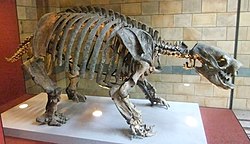
Glossotherium

Skeleton, Natural History Museum, London - DSCF0385.JPG

Kingdom: Animalia
Phylum: Chordata
Class: Mammalia
Order: Xenarthra
Family: Mylodontidae
Genus: Glossotherium
Species: G. robustum
               G. chapadmalense
Temporal Range: Late Pliocene to Early Holocene (2.5 - 0.010 ma)

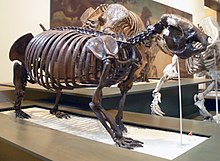
Its literal meaning is the Tongue Beast. It was a genus of ground sloth which was heavily built animal with a length of about 13 ft snout to tail-tip and a weight estimated at 1000 kg. They could potentially assume a slight bipedal stance.
They are generally wider and more robust with a dignostic increased amount of lateral flare at the predental spout. 
G. robustum was endemic to South America and weighted about 1500 kg. Pleistocene records indicate that it was widely distributed between 20 degree south to 40 degree south with a range spanning across Argentina, Chile, Uruguay, and Paraguay.
Sloths have ever-growing adult dentition. They lack deciduous dentition and have a reduction in tooth number. Sloth teeth also lack the enamel and cuspation pattern generally present in other mammals. Their tooth forms are oval, sub-rectangular or elongate irregular ovoid. cheek teeth in Glossotherium are larger, have more complex shapes and retain more of the cementum layer around all sides of each tooth than the shasta ground sloth and tree sloths.


Their diet is still unclear. However based on the dental evidence, it was likely more suited to grazing, though it was also probably less efficient at ingesting grasses since its dental apparatus was more suited to shearing which would have been too ineffective at processing plant materials down to an ingestible size to obtain adequate nutritive value. They have a very slow rate of passage of food through the gut. They could probably survive better on foods of lower nutritional value than other sloths could. They likely ate grasses, but also probably they ate a variety of foliage as well and would be better considered a browser-grazer than simple grazer.
They use the same way what the elephants do to communicate. sloths may have used low frequency sounds in melting calls or other social interactions of for long-range sound sensing as in predator-prey interactions or weather forecasting. Another possible explanation for hearing in low frequencies may be due to forssorial habits: low hearing frequencies coupled with a short interaural distance suggest that Glossotherium probably had very poor sound localization.This indicates evidence of an underground lifestyle since loss of high frequency hearing is common to fossorial mammals. Their huge nostrils were likely effective for sound emission with expanded nares possibly related to emission of low frequency sounds up to 600 Hz.
Due to its size and strength, Glossotherium would have had few natural enimies apart from Smilodon. It is believed to have died out in the Pleistocene (1.8 - 12,000 years ago). The most recent reported date is about 8700 years ago.
They have been found in South America and Mexico. It is closely related to Paramylodon of North America.Earliest Glossotherium specimens are known from the Pliocene of South America and are represented by the species, G. chapadmalense. All speciemens of Pleistocene age are typically lumped into G. robustum and a few other quentionalbe species. Further research is needed at the species level.

Thursday, 12 May 2016

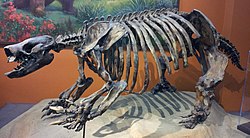
Mylodontidae

Paramylodon fossil at Texas Memorial Museum.jpg

Kingdom: Animalia
Phylum: Chordata
Class: Mammalia

Order: Pilosa
Family:  Mylodontidae
Mylodontidae is a family of extinct ground sloths which  lived about 22.89 million years from 23 million years ago to 11,000 million years ago.

Genus

Wednesday, 11 May 2016

Pronothrotherium

Pronothrotherium typicum.jpg

Kingdom: Animalia
Phylum: Chordata
Class: Mammalia
Order: Xenarthra
Family: Nothrotheriidae
Genus: Pronothrotherium
Species: P. typicum
Temporal Range: Miocene

It is an extinct genus of ground sloth of South America. They were from the Miocene Epoch. They may be familiar with the Marine life.

Nothrotherium

Nothrotherium.JPG

Kingdom: Animalia
Phylum: Chordata
Class: Mammalia
Order: Xenarthra
Genus: Nothrotherium
Species: N. maquinense Lund
               N. escrivanense
 It is an extinct genus of medium-sized ground sloth from South America and Mexico. It differs from Nothrotheriops in smaller size and differences in skull and hind leg bones, but genera can be traced back to Hapolops, the genus which both evolved from in different ecoloogical conditions. These browsing ground sloths consumed roots, stems, seeds and leaves of various desert plants, such as the yucca and agave.

Saturday, 9 April 2016

Hapalops


Kingdom: Animalia
Phylum: Chordata
Class: Mammalia
Order: Xenarthra
Family: Megatheriidae
Species: H. indifferens
               H. longiceps
               H. latus
               H. cadens
               H. congermanus
               H. gallaicus
Conservation Status: Extinct
Temporal Range: Late Oligocene - Miocene

Hapalops is extinct genus of ground sloth from the late Oligocene of South America. Though related to the giant Megatherium, Hapalops was much smaller, measuring about 1 meter in length. Like most extinct sloths it is categorized as a ground sloth, but it is believed that the smaller size of Hapalops allowed it to engage in some climbing behaviors.


It had a robust body, short skull and long limbs with large, curved claws. When it did visit the ground the animal probably walked on the knuckles of its forelimbs, like gorilla. Hapalops had very few teeth with no incisors, the mandible included only four pairs of teeth.

Saturday, 2 April 2016

Neocnus

Synocnus comes.jpg

Kingdom: Animalia
Phylum: Chordata
Class: Mamallia
Order: Pilosa
Family: Megalonychidae
Genus: Neocnus
Species: N. gliriformis
               N. major
               N. comes
               N. dousman
               N. toupiti
Conservation Status: Extinct
Temporal Range: Pleistocene

 Neocnus is an extinct genus of ground sloth, whose species ranged across Cuba and Hispaniola. Neocnus would have resembled a typical megalonychid ground sloth, though much smaller, with a longer tail and broad trunk, as well as lissome limbs and long claws. This sloth was known for having caudal vertebrae that were broad, a trait shared with other ground sloths, indicating that this animal like the tamandua of today, likely used its tail to stand  upright. The caniniform teeth of the Neocnus were large and triangular, and its skull was deep and large. 

The fossils of this sloth were found in Haitian cave deposits. They have been dated to as recently as 4391 BP, calibrated to 5000 BP. It is theorized that this sloth, in common with other Antillean sloths was killed off by humans seeking its pelt and meat. Currently, this species of sloth is being studied by evolutionary historians. Neocnus is suspected of having been semi-arboreal.

Megalocnus


Megalocnus rodens.JPG

Kingdom: Animalia
Phylum: Chordata
Class: Mammalia
Order: Pilosa
Family: Megalonychidae
Genus: Megalocnus
Species: M. redens
               M. zile
Conservation Status: Extinct
Temporal Range: Late Pleistocene to Holocene


The ground sloths of the extinct genus Megalocnus were among the largest of the Caribbean ground sloths, with individuals estimated to have weighted up to 90 kg when alive. Two species are known, M. rodens of Cuba and M. zile of Hispaniola. Megalocnus means great sloth. According to the fossil reports M. redens indicate survival well into the Holocene.

Thursday, 31 March 2016

Habanocnus


Kingdom: Animalia
Phylum: Chordata
Class: Mammalia
Order: Xenarthra
Family: Megalonychidae
Genus: Habanocnus
Species: H. hoffstetteri
               H. paulacounto

Habanocnus is an extinct genus of ground sloth. It is also known as the Havana Sloth. It is  indigenous to Late Pleistocene Cuba. There is not much significant excavation of these spices with what we can get some identification. What we gather, we can only say that Acratocnus and Habanocnus are taxonomic synonyms. There is not much identificational difference between these to genus.

Wednesday, 30 March 2016

Ancestral Malarial Organisms Traced to age of Dinosaurs

A new analysis of the prehistoric origin of malaria suggests that it evolved in insects at least 100 million years ago and the first vertebrate hosts of this disease were probably reptiles which at that time would have included the dinosaurs. The study also suggests that they  may have been involved in the extinction of the dinosaurs.

Source: American Entomologist

How Diet Shaped Human Evolution

The ancestor of modern humans shared the planet with Neanderthals, a close heavy-set relative that dwelled almost exclusively in Ice-Age Europe, until some 40,000 years ago. Neanderthals were similar to Homo sapiens, with whom they sometimes mated - but they were differences, Neanderthals were shorter and stockier with wider pelvises and rib-cages than their modern human counterparts.

But what was the reason behind the anatomical differences? A new study finds that the Ice-Age diet - a high-protein intake of large animals - triggered physical changes in Neanderthals, namely a larger ribcage and a wider pelvis.


According to the study, the bell-shaped Neanderthal rib-cage or thorax had to  evolve to accommodate a larger liver, the organ responsible for metabolizing great quantities of protein into energy. The heightened metabolism also required an expanded renal system to remove large amount of toxic urea, possibly resulting in a wide Neanderthal pelvis.

Source: Journal of Physical Anthropology

Acratocnus

acratocnus

Kingdom: Animalia
Phylum: Chordata
Class: Mammalia
Order: Pilosa
Genus: Acratocnus
Species: A. odontrigonus
              A. antillensis
              A. ye

Temporal Range: 2.5 mya - 5000 BP (Pleistocene to Holocene)

Acratocnus is an extinct genus of ground sloth found in Cuba, Hispaniola and Puerto Rico. It is a member of the family Megalonychidae, whose sole surviving genus is Choloepus (the two toed tree sloth)

Habanocnus.JPG 

HABITAT

The species of Acratocnus were found on the islands of Puerto Rico, Cuba and Hispaniola, where they inhabitat the montane forests of the highlands. The Puerto Rican ground sloth, Acratocnus odontrigonus is known from several poorly documented cave excavations in northwestern Puerto Rico. The various species are regarded as being semi-arboreal because of their small size and their large hooked claws.

SIZE

The various species of Acratocnus ranged in different weights. their weight varied from 22kg to 70 kg.This indicates that they are much larger than the living tree sloths as those are not more than 15 kg.


EXTINCTION

As with many sloth fossils, these species of sloth have not been radio-metrically dated. It is suggested that the Puerto Rican and Hispaniolan Acratocnus species survived into the late Pleistocene but disappeared by the mid-Holocene. According to the latest survival reports it is confirmed that there is no evidence of any kind of ground sloth in Cuba after 5000 BP. The causes of their extinction may have been climate changes or more likely human hunting or any kind of plague.

Saturday, 26 March 2016

Saber tooth cats hunted on the South America

There is no doubt that the saber tooth cat or known as the Smilodon lived and hunted in the the open, dry lands of the North America but there is no clear evidence that they also roamed the South American planes, until now a new research led by Professor Herve Bocherens, suggests that like the lion which today lives in the African savannah, the saber tooth cat inhabited the open.dry country found in South America during ice age.
 The researchers examined that the saber tooth cats did not eat animals which were at home in thickly wooded country. Their chief prey seems tp have been a camel-like, steppe-dwelling ungulate known to scientists as  Macrauchenia, and two species of giant sloth (Megatherium and Lestodon) - who unlike their surviving relatives, lived on the ground and could grow to several tonnes in weight. Several individual bones of the saber tooth cats were found together and contained similar isotopes which suggests that they may hunt togetger in group.
The saber tooth cat (Smilodon) evolved in North America and spread to South America with the formation of a stable land bridge between the two continents some three million years ago. It appears that the saber tooth cat's fiercest compititors were not other big cats. The study indicates that the jaguar preffered smaller prey, such as rodents and species of horse. But the ice age dog (Protocyon) seems to have shared the saber tooths culinary tastes. 

Source: University of Tubingen

Killer Fungus invades Europe

An invasive pathogenic fungus (Batrachochytrium salamandrivorans) is a threat to European salamander and newt biodiversity. Basal was originally discovered in the Netherlands because it caused mass mortality in salamanders and drove the infected populations to local extinction.  Subsequent laboratory trials showed most European salamander and newt die quickly after infection.
Using data from field surveillance, a new study showed that the killer fungus now occurs in many new places in the Netherlands and Belgium. In addition, it was found for the first time in the wild in Germany. The study also shows that the fungus infects additional species in the wild.
The international research team says that further surveillance of the chytrid fungus is very important .

Source: Ghent University