Showing posts with label SLOTH. Show all posts

Sunday, 15 May 2016

Chubutherium


Kingdom: Animalia
Phylum: Chordata
Class: Mammalia
Order: Xenarthra
Family: Mylodontidae
Genus: Chubutherium
Species: S. leptocephalum
               S. parodii
Conservation Status: Extinct
Temporal Range: Oligocene - Mid Miocene

Chubutherium ferelloii is an extinct species of ground sloth. They first appeared in the Oligocene and died out during the Middle Miocene. It is related to the Pleistocene genus, Scelidotherium. Only a few specimens have been found in Patagonia.

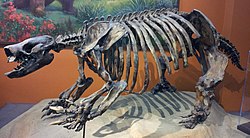
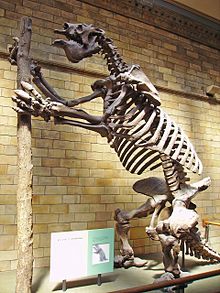
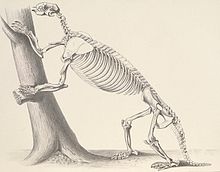
Scelidotherium

Scelidotherium leptocephalum side.jpg

Kingdom: Animalia
Phylum: Chordata
Class: Mammalia
Order: Xenarthra
Family: Mylodontidae
Genus: Scelidotherium
Species: S. leptocephalum
               S. parodii 

Scelidotherium is an extinct genus of ground sloth of the family Mylodontidae, endemic to South America during the middle Pleistocene epoch. It lived from 780,000 - 11,000 years ago. They existed for approximately 0.67 million years.
It is characterized by an elongated, superficially anteater-like head. It is known almost exclusively from Argentina, but its distribution may have extended into Paraguay and Uruguay.
The meaning of their name is femur Beast.
They were 3.6 ft tall and about 3000 kgs.

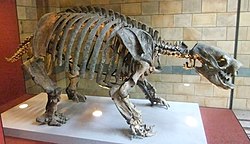
Paramylodon

San Diego Paramylodon.jpg

Kingdom: Animalia
Phylum: Chordata
Class: Mammalia
Order: Pilosa
Family: Mylodontidae
Genus: Paramylodon
Species: P. harlani
Temporal Range: Late Pliocene to Pleistocene (4.9 ma - 11,000 years ago)

It is an extinct genus of ground sloth of the family Mylodontidae endemic to North America during the Pliocene through Pleistocene epochs.
Paramylodon was about 9.8 ft in height and weighted as much as 1000 kg. It is known from North America deposits, including in Mexico and the United States and as far south as Guatemala. Currently there is just one recognized species, P. harlani. 
Recently a Paramylodon specimen was identified from the Tarkio Vallet site in Lowa association with Megalonyx. This is probably the first time these species have been found in close association. These two species have since been uncovered at  the Fairmead Landfill Site and Irvington Site in California.

Mylodon


Kingdom: Animalia
Phylum: Chordata
Class: Mammalia
Order: Pilosa
Family: Mylodontidae
Genus: Mylodon
Species: M. darwini
Temporal Range: Pleistocene to Holocene

It is a extinct genus of ground sloth that lived in the region South America until roughly 10,000 years ago. Exactly the fossil remains found in Argentina and Chile.
Mylodon's close relatives include the ground sloths of the genera has often been confused with Glossotherium and Paramylodon. Scientists often confused Mylodon with Glossotherium. 
Mylodon weighed about 2,500 kg and stood up to 10 ft when raised up on its hind legs. It had very thick hide and had osteoderms within its skin for added armor. Because of this armor and its long and sharp claws, it is unlikely that the Mylodon had any natural enemies other than humans, who would have still difficult to pierce with stone projectile points.
Mylodon has been traditionally considered a grazer in open areas, which is theorized based on its paleoenvironment as well as from the vegetation found in fossilized dung. However new study suggests that they  had been a mixed or selective-feeder instead and the paleoenvironment of the formation where the animal was found indicates a wide variety of vegetation to be selected from. 
The Mylodon had a wide range of climate and environment tolerance. It was probably capable of inhabiting arid to semiarid and cold climates, humid and warm climates and cooler and montane climates.

Saturday, 14 May 2016

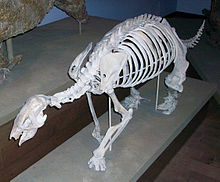
Lestodon

Lestodon armatus Ghedo.JPG

Kingdom: Animalia
Phylum: Chordata
Class: Mammalia
Order: Pilosa
Family: Mylodontidae
Genus: Lestodon
Species: L. armatus
Temporal Range: Pleistocene

It is an extinct genus of megafaunal ground sloth from South America during the Pleistocene period. Its fossil
remains have been found in Argentina, Paraguay, Uruguay and Bolivia. 4.6 (15ft) from snout to tail tip, it is estimated to have weighted about 4 tons. It was a herbivore and primarily fed on the grasses on the South American Plains and is thought to perhaps have used its semi-bipedal stance to obtain foliage from trees. The genus name Lestodon derives from the Greek for robber tooth.
Lestodon had a large, blunt and square mandible well adapted for foliage consumption. Its muzzle and dentition show significant adaption to this diet. The shape of the muzzle aided the ground sloth in the grazing necessary to sustain the metabolic activity of its large body, square,flat muzzles are associated with bulk feeders while pointed snouts are adaptive features of precision eaters. To sustain its coloric needs with plant matter, the sloth would have needed to be able to consume a high quantity of food with little precision. The species would dig its food, and would have accidentally ingested a large amount of grinity dirt and soil particulate. This gives them a large crown height, called hypsodonty that is unsuitable for strong bite forces. While the mandibular muscles would have been well developed to support the allometrically positive jaw of Lestodon, they would have also been extremely weak.
Researchers working at the Arroyo del Vizcaino site near Sauce, Uruguay, found evidence suggesting that Lestodon was hunted by humans about 30,000 years ago. This was discovered through the analysis of Lestodon bones. Deep slash markings on some of them were discovered the use of human stone tools.

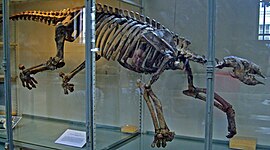
Glossotherium

Skeleton, Natural History Museum, London - DSCF0385.JPG

Kingdom: Animalia
Phylum: Chordata
Class: Mammalia
Order: Xenarthra
Family: Mylodontidae
Genus: Glossotherium
Species: G. robustum
               G. chapadmalense
Temporal Range: Late Pliocene to Early Holocene (2.5 - 0.010 ma)

Its literal meaning is the Tongue Beast. It was a genus of ground sloth which was heavily built animal with a length of about 13 ft snout to tail-tip and a weight estimated at 1000 kg. They could potentially assume a slight bipedal stance.
They are generally wider and more robust with a dignostic increased amount of lateral flare at the predental spout. 
G. robustum was endemic to South America and weighted about 1500 kg. Pleistocene records indicate that it was widely distributed between 20 degree south to 40 degree south with a range spanning across Argentina, Chile, Uruguay, and Paraguay.
Sloths have ever-growing adult dentition. They lack deciduous dentition and have a reduction in tooth number. Sloth teeth also lack the enamel and cuspation pattern generally present in other mammals. Their tooth forms are oval, sub-rectangular or elongate irregular ovoid. cheek teeth in Glossotherium are larger, have more complex shapes and retain more of the cementum layer around all sides of each tooth than the shasta ground sloth and tree sloths.


Their diet is still unclear. However based on the dental evidence, it was likely more suited to grazing, though it was also probably less efficient at ingesting grasses since its dental apparatus was more suited to shearing which would have been too ineffective at processing plant materials down to an ingestible size to obtain adequate nutritive value. They have a very slow rate of passage of food through the gut. They could probably survive better on foods of lower nutritional value than other sloths could. They likely ate grasses, but also probably they ate a variety of foliage as well and would be better considered a browser-grazer than simple grazer.
They use the same way what the elephants do to communicate. sloths may have used low frequency sounds in melting calls or other social interactions of for long-range sound sensing as in predator-prey interactions or weather forecasting. Another possible explanation for hearing in low frequencies may be due to forssorial habits: low hearing frequencies coupled with a short interaural distance suggest that Glossotherium probably had very poor sound localization.This indicates evidence of an underground lifestyle since loss of high frequency hearing is common to fossorial mammals. Their huge nostrils were likely effective for sound emission with expanded nares possibly related to emission of low frequency sounds up to 600 Hz.
Due to its size and strength, Glossotherium would have had few natural enimies apart from Smilodon. It is believed to have died out in the Pleistocene (1.8 - 12,000 years ago). The most recent reported date is about 8700 years ago.
They have been found in South America and Mexico. It is closely related to Paramylodon of North America.Earliest Glossotherium specimens are known from the Pliocene of South America and are represented by the species, G. chapadmalense. All speciemens of Pleistocene age are typically lumped into G. robustum and a few other quentionalbe species. Further research is needed at the species level.

Thursday, 12 May 2016

Mylodontidae

Paramylodon fossil at Texas Memorial Museum.jpg

Kingdom: Animalia
Phylum: Chordata
Class: Mammalia

Order: Pilosa
Family:  Mylodontidae
Mylodontidae is a family of extinct ground sloths which  lived about 22.89 million years from 23 million years ago to 11,000 million years ago.

Genus

Wednesday, 11 May 2016

Pronothrotherium

Pronothrotherium typicum.jpg

Kingdom: Animalia
Phylum: Chordata
Class: Mammalia
Order: Xenarthra
Family: Nothrotheriidae
Genus: Pronothrotherium
Species: P. typicum
Temporal Range: Miocene

It is an extinct genus of ground sloth of South America. They were from the Miocene Epoch. They may be familiar with the Marine life.

Nothrotherium

Nothrotherium.JPG

Kingdom: Animalia
Phylum: Chordata
Class: Mammalia
Order: Xenarthra
Genus: Nothrotherium
Species: N. maquinense Lund
               N. escrivanense
 It is an extinct genus of medium-sized ground sloth from South America and Mexico. It differs from Nothrotheriops in smaller size and differences in skull and hind leg bones, but genera can be traced back to Hapolops, the genus which both evolved from in different ecoloogical conditions. These browsing ground sloths consumed roots, stems, seeds and leaves of various desert plants, such as the yucca and agave.

Tuesday, 10 May 2016

Nothrotheriops

Nothrotheriops skeleton at Springs Preserve.jpg

Kingdom: Animalia
Phylum: Chordata
Class: Mammalia
Order: Xenarthra
Genus: Nothrotheriops
Species: N. shastensis
               N. texanus
Temporal Range: 2.6 - 0.011 ma

It is a genus of Pleistocene ground sloth found in North America, from what is now central Mexico to the southern United states. This genus of bear-sized xenarthran was related ti the much larger and far more famous Megatherium which was from the family Megatheriidae 
It was one of the smallest ground sloth species, it reached 9 ft from head to tail and weighted 550 lb which is much smaller than some of its contemporary species such as the Eremotherium, which could easily weigh over two tons and be 20 ft long. It had large, stout hind legs and a powerful, muscular tail that it used to forn a supporting tripod whenever it shifted from a quadrupedal stance to a bipedal one.
This genus's lineage dates back to the Miocene The ancestors of Nothrotheriops migrated to North America from South America as part of the Great American Interchange about 2.6 million years ago.
The best known historical specimen was found in a lava tube at Aden Crater in New Mexico; It was found with hair and tendon still preserved. Rampart Cave, in the Grand Canyon, Arizona has a plentiful amount of the sloth's hair and dung which allowed the scientists both to use radiocarbon dating techniques to establish when it lived. The most recent credible dates from this and each of about half a dozen other southwestern caves are about 11,000 BP.
It behaved like all typical ground sloths of North and South America, feeding on various plants like the desert globemallow, cacti and yucca. It was hunted by various local predators. Like Smilodon, from which the sloths may have defended themselves by standing upright on hindlegs and tail and swiping with their long foreclaws, like its distant relative Megatherium. The same claws could also been used as tools to reach past the plant spines and grab softer flowers and fruits. Also the have had a prehensile tongue like a giraffe to strip leaves off branches.
This sloth is believed to have played an important role in the dispersal of Joshua tree,seeds. Preserved dung belonging to the sloth has been found to contain Joshua tree leaves and seeds, confirming that they fed on the trees. It has been suggested that the lack of this ground sloths helping to disperse the seeds to more favourable climates is causing the trees to suffer.

Nothropus

Kingdom: Animalia
Phylum: Chordata
Class: Mammalia
Order: Pilosa
Family: Northorotheriidae
Genus: Nothoropus
Temporal Range: Early Pleistocene - Early Holocene

Nothropus is extinct genus of ground sloth of the family Nothrotheriidae, endemic to South America during the Pleistocene epoch. It lived from 0.781 mya - 12,000 years ago existing for approximately 0.769 million years.
Fossils have been uncovered from Tarija, Bolivia, east side of the Andes Mountains.

Thalassocnus

Thalassocnus.jpg

Kingdom: Animalia
Phylum:  Chordata
Class: Mammalia
Order: Pilosa
Genus: Thalassocnus
Species: T. antiquus
               T. natans
               T. littoralis
               T. carolomartini
               T. Yaucensis
Temporal Range: Late Miocene to Late Pliocene

It is an extinct genus of semi-aquatic or fully aquatic marine sloth from the Miocene and Pliocene of South America. Fossils found to date have been from the coast of Peru and Chile. They were apparently grazers of sea grass and seaweed. The various species of this genus provides the best-documented case of gradual adaptation ti a secondary aquatic lifestyle. This is documented both at the morphological level, such as a progressive flattening of the radius.and at the micro anatomical level, which shows a progressive increase in thickness and compactness of the long limb bones and ribs, providing ballast. They may have used their powerful claws to anchor themselves to the sea floor to facilitate feeding, simmilar to the behavior of the marine iguana.
The oldest species, T. antiquus, T. natans and T. littoralis show indications of partial adaptation to grazing with little evidence of transverse mandibular movement while eating, and abundant dental striae indicating ingestion of sand from feeding on vegetation stranded on beaches or or in shallow water. The later species T. carolomartini and T. yaucensis were apparently specialized grazers that fed in deeper water, they display distinct evidence of transverse mandibular movement and lack dental striae.

Mionothropus


Kingdom:  Animalia
Phylum: Chordata
Class: Mammalia
Order: Xenarthra
Family: Nothrotheriidae
Genus: Mionothropus
Species: M. cartellei
Temporal Range: 7.9 Ma

It is an extinct genus of the sloth family Nothrotheriinae which existed in Peru in western Amazonia, during the late Miocene. 

Nothrotheriidae


Kingdom: Animalia
Phylum: Chordata
Class: Mammalia
Order: Pilosa
Family: Nothrotheriidae
Temporal Range: 11.6 - 0.011 Ma

It is a family of extinct ground sloths that lived from approximately 11.6 mya - 11,000 years ago. During the late Miocene and Pliocene, the nothrotheriid Thalassocnus of the west coast of South America became adapted to a shallow water marine lifestyle.
The earliest nothrotheriid in North America was Nothrotheriops, which appeared at the beginning of the Pleistocene, about 2.6 Ma ago. Nothrotherium reached Mexico by the late Pleistocene.
The last ground sloths in North America belonging to Nothrotheriops died so recently that their dried subfossil dung has remained undisturbed in some caves, as if it were just recently deposited. 
The largest samples of Nothrotheriops dung can be found in the collections of Smithsonian Museum.

Genus:

Sunday, 8 May 2016

Pelecyodon

Pelecyodon cristatus.JPG

Kingdom: Animalia
Phylum: Chordatat
Class: Mammalia
Order: Pilosa
Family: Megatheriiidae
Genus: Pelecyodon
Species: P. arcuatus
               P. cristatus
               P. maximus
               P. petraeus
               P. robustus
Temporal Range: Late Oligocene - Miocene

Pelecyodon is an extinct genus of ground sloth from the late Oligocene of South America.

Prepotherium

Kingdom:  Animalia
Phylum: Chordata
Class: Mammalia
Order: Pilosa
Family: Megatheriidae
Genus: Prepotherium
Temporal Range: Prepotherium

Prepotherium is an extinct genus of Prepotheriina ground sloths that lived during the Miocene period. Fossils of them have been found in Argentina. Prepotherium differed from Megatherium by being smaller and having a less exaggeratedly convex inferior border of the lower jaw.
This species was reclassified in their own genus, Pseudoprepotherium as a basal member of another family of ground sloths, the Mylodontidae.

Promegatherium

Promegatherium nanum.JPG

Kingdom: Animalia
Phylum: Chordata
Class: Mammalia
Order: Xenarthra
Family: Megatheriidae
Genus: Promegatherium
Species: P. cabreri
               P. nanum

               P. parvulum
               P. remulsum
               P. smaltatum
 Temporal Range: Miocene Epoch
Promegatherium is a genus of prehistoric sloth that lived in South America, primarily Argentina during the Middle to upper Miocene. This genus is regarded as closely related to the later anmd more famous genus, Megatherium, hence the reference in the name. The first specimens of Promegatherium were originally described by the biologist Florentino Ameghino in 1887.

Sunday, 10 April 2016

Megatherium

Megatherium americanum Skeleton NHM.JPG

Kingdom: Animalia
Phylum: Chordata
Class: Mammalia
Order: Pilosa
Family: Megatheriidae
Genus: Megatherium
Species: M. amerucanum
               M. medinae
               M. istilarti
               M. parodii
               M. sundti
               M. gallardoi

Temporal Range: Middle Pliocene to Early Holocene

Megatherium was a genus of ground sloths endemic to South America that lived from the Middle Pliocene through the end of the Pleistocene. Megatherium means great beast. Its size was exceeded by only a few other land mammals, including mammoths and paraceratherium.
The first fossil specimen of this creature was discovered in 1788 by Manuel Torres, on the bank of the Lujan river in Argentina.

Evolution

During the Pliocene, the Central American Isthmus formed, casing the Great American Interchange, and a mass extinction of much of the South American megafauna. Ground sloths were largely unaffected and continued to thrive in spite of competition from the northern immigrants. Ground sloths among the various South American animal groups to migrate northwards into North America, where they remained unflourished until the Late Pleistocene.
Promegatherium is suggested as the ancestor of Megatherium. The oldest species of Megatherium is M. altiplanicum of Pliocene. It was very similar to Promegatherium and was also about the same size. M. tarijense has been regarded as a medium-sized Megatherium species, larger than M. altiplanicum but smaller than M. americanum. It roamed from Bolivia to Peru. Species of Megatherium became larger over time with largest species M. americanum of the late Pleistocene. It was about the size of an African  Elephant.

Description

Megatherium weighing up to 4 tonnes and mesuring up to 6 m in length from head to tail. It is largest known ground sloth and would have only been exceeded in its time by a few species of mammoth. It has a robust skeleton with a large pelvic girdle and a broad muscular tail. Its large size enabled it to feed at heights unreachable by other contemporary herbivores. It could support its massive body weight while using the curved claws on its long forelegs to pull down branches with the choicest leaves. Studies also suggest that it had adaptations to bipedalism. Some experts believe that its jaw may have housed a long tongue which it would use to pull leaves into its mouth, similar to the modern tree sloth.It was well adapted for strong predonimatly orthal movement for eating rough vegetation. It was a selective eater.


Habitat

Megatherium inhabited woodland and grassland environment of the lightly wooded areas of South America where it was an endemic species, as recently as 10000 years ago. According to the fossil study, it is believed that they were adaptable to temperate, arid or semiarid open habitats.

Behavior

The giant ground sloth lived mostly in groups, but it may have lived singly in caves. It probably had mainly a browsing diet in open habitats, but also it  probably fed on other moderate to soft tough food. For millions of years, the sloth did not have many enemies to bother it, so it was probably a diurnal animal.

Predators

Because of its size and its deadly claws there are not much predators of this sloth. Though from some studies it is come to know that the Saber tooth cats took sloths as their diet. Now another recent research also indicates that Saber tooth cat also hunt in the lands of South America. So it is very much likely that the saber tooth cat is may  be the only predator that have a chance against this massive creature.

Diet

 They were herbivore animal; feeding on leaves such as yuccas, agaves and grasses. While it fed chiefly on terrestrial plants, it could also stand on its hind legs, using its tail as a balancing tripod. and reach for upper growth vegetation. The sloth's stomach was able to digest coarse and fibrous food. It is likely that it spent a lot of time resting to aid digestion.


Extinction

In the south, the giant ground sloth flourished until about 10,500  BP. Most cite the appearance of an expanding population of human hunters as the cause of its extinction. There are a few dates of around 8000 BP and one of 7000 BP for megatherium remains, but the most recent date viewed as credible is about 10,000 BP. The use of bioclimatic envelope modeling indicates that the area of suitable habitat for Megatherium had shrunk and become fragmented by the mid-Holocene. While this alone would not likely have caused its extinction. it has been cited as a possible contributing factor.

Saturday, 9 April 2016

Hapalops


Kingdom: Animalia
Phylum: Chordata
Class: Mammalia
Order: Xenarthra
Family: Megatheriidae
Species: H. indifferens
               H. longiceps
               H. latus
               H. cadens
               H. congermanus
               H. gallaicus
Conservation Status: Extinct
Temporal Range: Late Oligocene - Miocene

Hapalops is extinct genus of ground sloth from the late Oligocene of South America. Though related to the giant Megatherium, Hapalops was much smaller, measuring about 1 meter in length. Like most extinct sloths it is categorized as a ground sloth, but it is believed that the smaller size of Hapalops allowed it to engage in some climbing behaviors.


It had a robust body, short skull and long limbs with large, curved claws. When it did visit the ground the animal probably walked on the knuckles of its forelimbs, like gorilla. Hapalops had very few teeth with no incisors, the mandible included only four pairs of teeth.

Eremotherium


Kingdom: Animalia
Phylum: Chordata
Class: Mammalia
Order: Pilosa
Family: Megatheriidae
Genus:  Eremotherium
Species: E. laurillardi
               E. eomigrans
               E. rusconi
Temporal Range: Late Pliocene - Pleistocene

Eremotherium is an extinct genus of ground sloth of the family Megatheriidae, endemic to North America and South America during the Pleistocene epoch. It roamed the planet for about 5 million years. It is a solitary beast.


It is about 6 meters long herbivore animal with long deadly claws. It is one of the largest ground sloth of all time.
The fossils have been uncovered from Chaltham County, Georgia, Berkeley County, South Carolina; Espirito Santo, and Pedra Preta, Brazil; Tarapoto, Peru; Rio Canas, Ecuador.
 E. eomigrans fossil was found in Florida only. It lived from 4.9 mya - 300,000 years ago. (4.6 million years)
E. laurillardi fossil was from the southern U.S. to Brazil. It lived from 780,000 - 11,000 years ago. (0.769 million years)