Showing posts with label SPECIES. Show all posts

Thursday, 2 June 2016

Meet Our newest Ancestors Homo Naledi

                                                    Homo Naledi
Domain : Eukarya
Kingdom : Animalia
Phylum : Chordata
Subphylum : Vertebrata
Class : Mammalia
Order : Primates
Family : Hominidae
Sub Family : Homininae
Tribe : Hominini
Subtribe : Hominina
Genus : Homo
Species : Homo Naledi

A team of Paleoanthropologists under Lee Berger went into the Rising Star Cave in Gauteng Province in South Africa in 2013 and till 2016 fossils were found there and these fossils have been proposed to represent he extinct species of the hominin Homo Naledi.


 The Rising Star Cave


The excavation team consisted six paleoanthropologists who were all female and could pass through an openeing only seven inches ( 18 cm ) wide to acess the Dinaledi chamber. Those chosen were Hannah Morris , Marina Elliot , Becca Peixotto , Alia Gurtov , Lindsay Eaves and Ellen Feuerriegel.
They have since been named the Underground Astronauts .
More than 1200 fossils were found in the Dinaledi Chamber and catalouged in November 2013 representing atleast a dozen individuals . Only 20 out of 206 bones of the human body were not found in the chamber.

As of September 2015 fossils of atleast 15 individuals , amounting to 1550 specimens , had been excavated from the cave. About 300 bone fragments were found from the surface of the Dinaledi  Chamber  and about 1250 fossil specimens  were recovered from the chamber's excavation pit . The fossils include skull ,jaws , ribs , teeth , bones of an almost complete foot , of a hand and of an inner ear. The bones of old , young and infant individuals were found .


ARTISTS IMPRESSION OF THE HOMO NALEDI


Anthropologist John D Hawkes from the University of Wisconsin Madinson who was a member of the team stated that the scientific facts are that all bones recovered are hominid except for those of an owl. There is no sign of predation and and there is no predator that  accumulates  only hominids this way and the bones were not accumulated here all at once . There is no evidence of rocks falling into the cave along with the  bones or the bones having been flown here along with water . Lee Berger and his team have suggested that the best hypothesis that these individuals were capable of ritualistic behaviour . They speculate that the placing of dead bodies in the cave was a ritualistic behaviour , a sign of symbolic thought which implies that they had intelligence and were similar to human species


The homo naledi fossils are the largest collection of fossils found of a single species of hominin in Africa and provides information about the early evolution of humans.


Picture Right - Skeletons Discovered
Tuesday, 10 May 2016

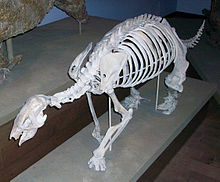
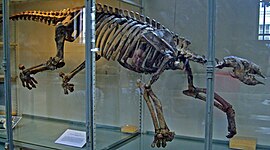
Nothrotheriops

Nothrotheriops skeleton at Springs Preserve.jpg

Kingdom: Animalia
Phylum: Chordata
Class: Mammalia
Order: Xenarthra
Genus: Nothrotheriops
Species: N. shastensis
               N. texanus
Temporal Range: 2.6 - 0.011 ma

It is a genus of Pleistocene ground sloth found in North America, from what is now central Mexico to the southern United states. This genus of bear-sized xenarthran was related ti the much larger and far more famous Megatherium which was from the family Megatheriidae 
It was one of the smallest ground sloth species, it reached 9 ft from head to tail and weighted 550 lb which is much smaller than some of its contemporary species such as the Eremotherium, which could easily weigh over two tons and be 20 ft long. It had large, stout hind legs and a powerful, muscular tail that it used to forn a supporting tripod whenever it shifted from a quadrupedal stance to a bipedal one.
This genus's lineage dates back to the Miocene The ancestors of Nothrotheriops migrated to North America from South America as part of the Great American Interchange about 2.6 million years ago.
The best known historical specimen was found in a lava tube at Aden Crater in New Mexico; It was found with hair and tendon still preserved. Rampart Cave, in the Grand Canyon, Arizona has a plentiful amount of the sloth's hair and dung which allowed the scientists both to use radiocarbon dating techniques to establish when it lived. The most recent credible dates from this and each of about half a dozen other southwestern caves are about 11,000 BP.
It behaved like all typical ground sloths of North and South America, feeding on various plants like the desert globemallow, cacti and yucca. It was hunted by various local predators. Like Smilodon, from which the sloths may have defended themselves by standing upright on hindlegs and tail and swiping with their long foreclaws, like its distant relative Megatherium. The same claws could also been used as tools to reach past the plant spines and grab softer flowers and fruits. Also the have had a prehensile tongue like a giraffe to strip leaves off branches.
This sloth is believed to have played an important role in the dispersal of Joshua tree,seeds. Preserved dung belonging to the sloth has been found to contain Joshua tree leaves and seeds, confirming that they fed on the trees. It has been suggested that the lack of this ground sloths helping to disperse the seeds to more favourable climates is causing the trees to suffer.

Nothropus

Kingdom: Animalia
Phylum: Chordata
Class: Mammalia
Order: Pilosa
Family: Northorotheriidae
Genus: Nothoropus
Temporal Range: Early Pleistocene - Early Holocene

Nothropus is extinct genus of ground sloth of the family Nothrotheriidae, endemic to South America during the Pleistocene epoch. It lived from 0.781 mya - 12,000 years ago existing for approximately 0.769 million years.
Fossils have been uncovered from Tarija, Bolivia, east side of the Andes Mountains.

Thalassocnus

Thalassocnus.jpg

Kingdom: Animalia
Phylum:  Chordata
Class: Mammalia
Order: Pilosa
Genus: Thalassocnus
Species: T. antiquus
               T. natans
               T. littoralis
               T. carolomartini
               T. Yaucensis
Temporal Range: Late Miocene to Late Pliocene

It is an extinct genus of semi-aquatic or fully aquatic marine sloth from the Miocene and Pliocene of South America. Fossils found to date have been from the coast of Peru and Chile. They were apparently grazers of sea grass and seaweed. The various species of this genus provides the best-documented case of gradual adaptation ti a secondary aquatic lifestyle. This is documented both at the morphological level, such as a progressive flattening of the radius.and at the micro anatomical level, which shows a progressive increase in thickness and compactness of the long limb bones and ribs, providing ballast. They may have used their powerful claws to anchor themselves to the sea floor to facilitate feeding, simmilar to the behavior of the marine iguana.
The oldest species, T. antiquus, T. natans and T. littoralis show indications of partial adaptation to grazing with little evidence of transverse mandibular movement while eating, and abundant dental striae indicating ingestion of sand from feeding on vegetation stranded on beaches or or in shallow water. The later species T. carolomartini and T. yaucensis were apparently specialized grazers that fed in deeper water, they display distinct evidence of transverse mandibular movement and lack dental striae.

Mionothropus


Kingdom:  Animalia
Phylum: Chordata
Class: Mammalia
Order: Xenarthra
Family: Nothrotheriidae
Genus: Mionothropus
Species: M. cartellei
Temporal Range: 7.9 Ma

It is an extinct genus of the sloth family Nothrotheriinae which existed in Peru in western Amazonia, during the late Miocene. 

Nothrotheriidae


Kingdom: Animalia
Phylum: Chordata
Class: Mammalia
Order: Pilosa
Family: Nothrotheriidae
Temporal Range: 11.6 - 0.011 Ma

It is a family of extinct ground sloths that lived from approximately 11.6 mya - 11,000 years ago. During the late Miocene and Pliocene, the nothrotheriid Thalassocnus of the west coast of South America became adapted to a shallow water marine lifestyle.
The earliest nothrotheriid in North America was Nothrotheriops, which appeared at the beginning of the Pleistocene, about 2.6 Ma ago. Nothrotherium reached Mexico by the late Pleistocene.
The last ground sloths in North America belonging to Nothrotheriops died so recently that their dried subfossil dung has remained undisturbed in some caves, as if it were just recently deposited. 
The largest samples of Nothrotheriops dung can be found in the collections of Smithsonian Museum.

Genus:

Sunday, 8 May 2016

Pelecyodon

Pelecyodon cristatus.JPG

Kingdom: Animalia
Phylum: Chordatat
Class: Mammalia
Order: Pilosa
Family: Megatheriiidae
Genus: Pelecyodon
Species: P. arcuatus
               P. cristatus
               P. maximus
               P. petraeus
               P. robustus
Temporal Range: Late Oligocene - Miocene

Pelecyodon is an extinct genus of ground sloth from the late Oligocene of South America.

Prepotherium

Kingdom:  Animalia
Phylum: Chordata
Class: Mammalia
Order: Pilosa
Family: Megatheriidae
Genus: Prepotherium
Temporal Range: Prepotherium

Prepotherium is an extinct genus of Prepotheriina ground sloths that lived during the Miocene period. Fossils of them have been found in Argentina. Prepotherium differed from Megatherium by being smaller and having a less exaggeratedly convex inferior border of the lower jaw.
This species was reclassified in their own genus, Pseudoprepotherium as a basal member of another family of ground sloths, the Mylodontidae.

Promegatherium

Promegatherium nanum.JPG

Kingdom: Animalia
Phylum: Chordata
Class: Mammalia
Order: Xenarthra
Family: Megatheriidae
Genus: Promegatherium
Species: P. cabreri
               P. nanum

               P. parvulum
               P. remulsum
               P. smaltatum
 Temporal Range: Miocene Epoch
Promegatherium is a genus of prehistoric sloth that lived in South America, primarily Argentina during the Middle to upper Miocene. This genus is regarded as closely related to the later anmd more famous genus, Megatherium, hence the reference in the name. The first specimens of Promegatherium were originally described by the biologist Florentino Ameghino in 1887.

Monday, 25 April 2016

Diprotodon


Kingdom: Animalia
Phylum: Chordata
Class: Mammalia 
Order: Diprotodontia
Family: Diprotodontidae
Genus: Diprotodon
Species: D. optatum

Diprotodon, meaning "two forward teeth" is the largest known marsupial ever to have lived. Along with many other members of a group of unusual species collectively called the Australian megafauna, it existed from approximately 1.6 million years ago until extinction some 46,000 years ago.
The closest surviving relatives of Diprotodon are the wobats and the  koala. It is suggested that diprotodonts may have been an inspiration for the legends of the bunyip as some Aboriginal tribes identify identify Diprotodon bones as those of bunyips.

Diprotodon australis skeleton 1.JPG

Description

Diprotodon superficially resembled a rhinoceros without a horn. Its feet turned inwards like a wombat's giving it a pigeon-toed appearance it had strong claws on the front feet and its pouch opening faced backward. Footprints of its feet have been found showing a covering of hair which indicates it had similar to a modern wombat. Until recently it was unknown how many species of Diprotodon had existed. Eight species are described although many researchers believed these actually represented only three at most while some estimated there could be around twenty in total.
Up to 3.8 , long (head tail) and 1.7 m at the shoulder.

Habitat

Diprotodon is known from many sites across Australia, including the Darling Downs in southeastern Queensland; Wellington Caves, Tambar Springs Cuddie Springs in New South Wales; Bacchus Marsh in Victria,; Diprotodon is not known from New Guinea, southwestern Western Australia, the Northern Territory oor Tasmania. Diprotodon preferred semi-arid plains, savannahs and open woodlands,and is generally absent from hilly, forested coastal regions. Diprotodon is known from some coastal localities, including Naracoorte Caves and Kangaroo Island in South Australia. However, these areas may have been  further from the coast in the Pleistocene when sea levels were lower.
Australian Pleistocene habitats changed over time in response to the changing climate. Dry, windy conditions alternatated with more equable conditions throughout this period and sea levels were generally much lower than today as ice was locked in polar regions. Extended droughts would have made much of inland Australia uninhabitable; hundreds of individuals have been found at the center of Lake Calabonna in northern South Australi, trapped in the mud as the lake bed dried  out. On the Darling Downs in Queensland, one study of Diprotodon habitat has found that areas once covered in woodlands, vine thickets and scrublands gave way to grasslands as the climate became drier.

Evolution

It is unlikely that Diprotodon moved in large herds, as sometimes depicted. Marsupials are not known to form large groups. The large numbers of individuals found at Lake Callabonna were probably smaller family groups drawn en masse to the drying waterhole. Diprotodontids first appear in the Oligocene, about 25 million years ago. These early diprotodontids were probably descended from late Oligocene to early Miocene to early Miocene wynyardiids and were about the size of sheep.
The subfamily Diprotodontinae, including Diprotodon optatum, are a Pliocene-Pleistocene group.  Diprotodon may have evolved from the Pliocene diprotodontine Euryzygoma during the late Pliocene. A recent study based on dentition has found that there is just a single variable species of Diprotodon, Diprotodon optatum.

Diet

Diprotodon was probably a browser, feeding on shrubs and forbs. One skeleton from Lake Callabonna had the remains of saltbush in its abdominal region. Diprotodon may have eaten as much as 100 to 150 kilograms of vegetation daily. Its chisel-like incisors may have been used to root out vegetation.

Behavior

In diprotodon, male was considerably larger than the females. There was a high degree of morphological difference between the sexes. In living sexually dimorphic mammals, breeding is usually polygynous i. e. males mate with multiple females over the breeding season. Diprotodon may also have used such a breeding strategy. 
There is some evidence of either predation or scavenging of diprotodon by the Pleistocene marsupial lions.

EXTINCTION

Most modern researchers including argue that diprotodonts, along with a wide range of other Australian megafauna, became extinct shortly after humans arrval in Australia about 50,000 years ago.
The recent ice ages produced no significant glaciation in the mainland Australia but long periods of cold and very dry weather. This dry weather during the last ice age may have killed off all the large diprodonts. But this cannot be the main cause because all the megafauna of Australia died in that same time period. Climate change apparently peaked 25,000 years after the extinctions.
May be the human arrival is the main reason of the extinction of the megafauna in Australia  This species died out just after the arrival of the Human. Diprotodon were herbivorous animals so they lived around the grassland or vegetation. Human also lived in the same habitat. Now Diprotodon drew the carnivores to this habitat which hunted the humans too. To reduce these, human killed diprotodons which also reduced the arrival of the carnivores. The human may also killed them for meat.

Sunday, 17 April 2016

Marsupial Lion

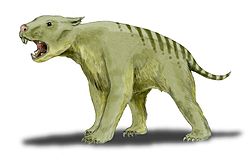
Thylacoleo BW.jpg

Kingdom: Animalia
Phylum: Chordata
Class: Mammalia
Order: Diprotodontia
Family: Thylacoleonidae
Genus: Thylacoleo
Species: T. carnifex
Temporal Range: Early - Late Pleistocene

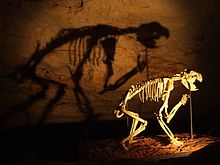
The marsupial lion is an extinct species of carnivorous marsupial mammal that lived in Australia.This is the last and largest member of the Thylacoleondae. Despite its name, it is not closely related to the lion, but is a member of the order Diprotodontia.

Description

The marsupial lion is the largest meat-eating mammal known to have ever existed in Australia and one of the largest marsupial carnivores from anywhere in the world. Individuals are about 75 cm high at the shoulder and about 150 cm from head to tail. Its up to 160 kg in weight. 
The animal was extremely robust with powerfully built jaws and very strong fore limbs. It possessed retractable claws, a unique trait among marsupials. This would have allowed the claws to remain sharp by protecting them from being worn down on hard surfaces.The claws were well-suited to securing prey and for climbing trees. The thumbs of each hand were semi-opposable and bore an enlarged claw. This would have been used to grapple its intended prey as well as providing it with a sure footing on tree trunks and branches. The marsupial lion had a relative thick and strong tail. Like the kangaroos, these marsupial lions also used its tail to support itself when on its hind legs. Taking this stance would free up its fore limbs to takle or slash at its intended victim.
The jaw muscle of the marsupial lion jaws exceptionally large for its size, giving it an extremely powerful bite. Biometric calculations shows considering size, it had the strongest bite of any known mammal, living or extinct. a 101 kg individual would have had a bite comparable to that of a 250 kg African lion. The skull was so specialized for big games.It was very inefficient at catching smaller animals.

Habitat

Thylacoleo was widely distributed across Australia during the Pleistocene. It has been found in all Australian states. Most of the sites where Thylacoleo fossils have been found are interpreted as dry, open forest habitat.
 

Evolution

The evolution of these marsupial lions were very interesting. It is believed that the ancestors of the marsupial lions had been herbivores, which is unusual for carnivores but it is confirmed that this Thylacoleonids share a common ancestor with wombats. While other continents were sharing many of their predators amongst themselves, as they were connected by land. Australia's isolation caused many of its normality docile herbivorous species to turn carnivorous. Possum-like features were once thought to indicate that the marsupial lion's evolutionary path was from a phalangeriform ancestor, however, scientists agree that more prominent features suggest a vombatiform ancestry.

Behavior

The marsupial lion was a powerful animal but it was not a particularly fast runner. Most probably the marsupial lions were solitary. Their are not much Social behavior is known about these marsupial lions.

Diet

The diet of the marsupial lions has been the subject of much debate. Thylacoleo has been described as a carnivore, a bone crusher, a scavenger or perhaps even an herbivore. It was first described as One of the fellest and most destructive of predatory beasts.
Recently from CT Scan of their skull we came to know, they had a very good senses of hearing, sight and smell. From this we expect, they are active predators.
Again their unusual teeth and herbivorous ancestry suggested, they are herbivores.
And from the hind leg structure it is confirmed that they are not fast runner, but their body is heavily built which means they can frighten other comparatively small predators and they did that and scavenge food from them.
Now to exist and dominate the landscape every animal uses their all strength. Then why not these marsupial lions. What may be happened was like this -- They are active predators, a deadly scavenger and a herbivore too if needed.
crocodile eggs, carrion, meat and bone marrows were their suggested diet for them. They also take megafauna's as their meal.
The are not suited to catching smaller prey, they are ambush hunter. It would have coexisted with many of the so-called Australian megafauna such as the previously mentioned Diprotodon, giant kangaroos are Megalania as well as giant wallabies like Protemnodon, the giant wombat Phascolonus and the thunderbird Genyornis. All of these Pleistocene megafauna would have been the prey for the marsupial lion who was especially adapted for hunting large animals.

Extinction

 As for most of the Australian megafauna, the events leading to the extinction of T. carnifex remain unclear. The hypothesized causes are the impacts of long-term climate change (both in the higher frequency extreme weather events and more subtle shift in temperature regimes, rainfall patterns etc.), hunting pressure and habitat changes imposed by humans.
When modern humans first arrived in Australia likely more than 60,000 years ago. it is thought that they had substantial impacts on the ecosystem by efficiently hunting large animals and by altering vegetation patterns through fire-stick farming. This has frequently been implicated in the disappearance of the majority of large Australian animals during the Pleistocene. On the other hand, many Australian fossil sites have yielded records of megafauna disappearance well before human presence in the area, giving weight to the interpretation that other factors most likely climate-related were the prominent drivers. The question remains the subject of ongoing research.

Wednesday, 13 April 2016

Genyornis


Kingdom: Animalia
Phylum: Chordata
Class: Aves
Order: Anseriformes
Family: Dromornithidae
Genus: Genyornis
Species: G. newtoni
Temporal Range: Late Pleistocene

The beak of Genyornis was a large, flightless bird that lived in Australia, over two meters in height, they became 50 thousand years ago. Many other species became extinct in Australia around that time, coinciding with arrival of humans.

Description

Genyomis was a large flightless bird, considerably taller and heavier  than the modern ostrich or emu. It had powerful legs and tiny wings and probably most closely resembled its living relatives duck and geese. But instead of having webbed feet and a duckbill, Genyornis had large hoof-like claws on its toes and a big beak. Like modern birds, it had no teeth but relied on gizzard to assist its digestion. Genyornis was over two meters tall and would weighed from 220-240 kilograms. Eggshell fragments have been recovered in sand dune deposits. The eggs of Genyornis were large, up to 1.6kg, almost twice the volume of emu eggs, smooth in texture and less elongate than emu eggs.
Genyornis

Habitat

Genyornis fossils are known from Lake Callabonna, Baldina Creek, Mt. Gambier, Salt Creek and Naracoorte Caves in South Australia, and from Wellington Caves and Cuddie Spring in New South Wales. Eggshell fragments have been found in dune deposits in South Australia and footprints, possibly those of Genyornis, have been found in Pleistocene dunes in Southern Victoria.
Genyornis had a wide distribution in a variety of habitats but seems to have preferred open forest and savannah-grasslands to more and more closed forest habitat preferred by earlier mihirungs. Eggshell fragments have been found in sand dunes and Genyornis may have used these dunes as nesting sites. A shift  to grasslands and increasing aridification in some areas may have favored the emu in some regions which may then have replaced Gyornis in local faunas.

Click here to view larger image.

Diet

The Diet of the whole Dromornithidae family has been the subject of much debate. Many palaeontologists are convinced that dromonithids were mainly if not exclusively herbivorous. Dromornithids lack a hooked beak, as in raptors and have hoof-like rather than recurved claws on their feet. Analysis of eggshells supports an herbivorous diet. Dromornithids are also found in large numbers in some deposits, unlike carnivores which at the top of the food chain, are generally very rare. A minority view holds that dromornithids were to some degree carnivorous, citing the huge size of the beak.
The diet of Genyornis has been determined by any direct evidence although  it appears to have been herbivorous. Fossils of Genyornis have been found with pebbles in the gizzard region, which are unknown in carnivores. Gastroliths wold have been used to help break up its food, as they do in other herbivorous birds. It is quite possible, given its anatomy and discovery of gastroliths, that Genyornis was herbivorous but the larger Bullockornis and Dromornis had a more varied diet.

Click here to view larger image.

Evolution 

Once thought to be ratites, dromornithids are now believed to be either within Anseriformes or just basal to  it. Recent revisions of the taxonomy of other large, flightless birds place these taxa within Anseriformes. All of these large birds, including the dromornithids, have a short dentary symphysis and a dorsally directed pterygoid process on the quadrate, unusual features not related to flightlessness. This revision is still debated, although many feel that the general placement of at least dromornithids, somewhere near the base anseriform radiation has merit.

Life Cycle

The eggs of Genyornis have been found in sand dune deposits which have also preserved the eggshells of emus. These dunes may have served as breeding grounds for both species, Hole similar to those made by mammalian canine teeth have been found in some Genyornis eggshell fragments. The size of these holes suggests that the predators were either Tasmanian devils or eastern quolls, both of which are known from the dune deposits.
Genyornis BW.jpg

Extinction

Human impact and climate change are the main two reason behind the extinction of this birds. A study has been performed in which more than 700 Genyornis eggshell fragments were dated. Through this, it was determined that Genyornis declined and became extinct over a short period. That short period is so short that climate change can not be the only and definitely the main reason behind that extinction. According to research studies, it is confirmed that the extinction of this birds in Australia was due to human activity rather than climate change. Human killed this bird for meat and they also take their eggs for meal. many eggs were found burned in fire (they are well cooked) which means human took those as meal.

Sunday, 10 April 2016

Megatherium

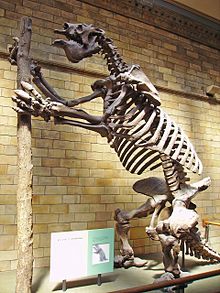
Megatherium americanum Skeleton NHM.JPG

Kingdom: Animalia
Phylum: Chordata
Class: Mammalia
Order: Pilosa
Family: Megatheriidae
Genus: Megatherium
Species: M. amerucanum
               M. medinae
               M. istilarti
               M. parodii
               M. sundti
               M. gallardoi

Temporal Range: Middle Pliocene to Early Holocene

Megatherium was a genus of ground sloths endemic to South America that lived from the Middle Pliocene through the end of the Pleistocene. Megatherium means great beast. Its size was exceeded by only a few other land mammals, including mammoths and paraceratherium.
The first fossil specimen of this creature was discovered in 1788 by Manuel Torres, on the bank of the Lujan river in Argentina.

Evolution

During the Pliocene, the Central American Isthmus formed, casing the Great American Interchange, and a mass extinction of much of the South American megafauna. Ground sloths were largely unaffected and continued to thrive in spite of competition from the northern immigrants. Ground sloths among the various South American animal groups to migrate northwards into North America, where they remained unflourished until the Late Pleistocene.
Promegatherium is suggested as the ancestor of Megatherium. The oldest species of Megatherium is M. altiplanicum of Pliocene. It was very similar to Promegatherium and was also about the same size. M. tarijense has been regarded as a medium-sized Megatherium species, larger than M. altiplanicum but smaller than M. americanum. It roamed from Bolivia to Peru. Species of Megatherium became larger over time with largest species M. americanum of the late Pleistocene. It was about the size of an African  Elephant.

Description

Megatherium weighing up to 4 tonnes and mesuring up to 6 m in length from head to tail. It is largest known ground sloth and would have only been exceeded in its time by a few species of mammoth. It has a robust skeleton with a large pelvic girdle and a broad muscular tail. Its large size enabled it to feed at heights unreachable by other contemporary herbivores. It could support its massive body weight while using the curved claws on its long forelegs to pull down branches with the choicest leaves. Studies also suggest that it had adaptations to bipedalism. Some experts believe that its jaw may have housed a long tongue which it would use to pull leaves into its mouth, similar to the modern tree sloth.It was well adapted for strong predonimatly orthal movement for eating rough vegetation. It was a selective eater.


Habitat

Megatherium inhabited woodland and grassland environment of the lightly wooded areas of South America where it was an endemic species, as recently as 10000 years ago. According to the fossil study, it is believed that they were adaptable to temperate, arid or semiarid open habitats.

Behavior

The giant ground sloth lived mostly in groups, but it may have lived singly in caves. It probably had mainly a browsing diet in open habitats, but also it  probably fed on other moderate to soft tough food. For millions of years, the sloth did not have many enemies to bother it, so it was probably a diurnal animal.

Predators

Because of its size and its deadly claws there are not much predators of this sloth. Though from some studies it is come to know that the Saber tooth cats took sloths as their diet. Now another recent research also indicates that Saber tooth cat also hunt in the lands of South America. So it is very much likely that the saber tooth cat is may  be the only predator that have a chance against this massive creature.

Diet

 They were herbivore animal; feeding on leaves such as yuccas, agaves and grasses. While it fed chiefly on terrestrial plants, it could also stand on its hind legs, using its tail as a balancing tripod. and reach for upper growth vegetation. The sloth's stomach was able to digest coarse and fibrous food. It is likely that it spent a lot of time resting to aid digestion.


Extinction

In the south, the giant ground sloth flourished until about 10,500  BP. Most cite the appearance of an expanding population of human hunters as the cause of its extinction. There are a few dates of around 8000 BP and one of 7000 BP for megatherium remains, but the most recent date viewed as credible is about 10,000 BP. The use of bioclimatic envelope modeling indicates that the area of suitable habitat for Megatherium had shrunk and become fragmented by the mid-Holocene. While this alone would not likely have caused its extinction. it has been cited as a possible contributing factor.

Saturday, 9 April 2016

Eremotherium


Kingdom: Animalia
Phylum: Chordata
Class: Mammalia
Order: Pilosa
Family: Megatheriidae
Genus:  Eremotherium
Species: E. laurillardi
               E. eomigrans
               E. rusconi
Temporal Range: Late Pliocene - Pleistocene

Eremotherium is an extinct genus of ground sloth of the family Megatheriidae, endemic to North America and South America during the Pleistocene epoch. It roamed the planet for about 5 million years. It is a solitary beast.


It is about 6 meters long herbivore animal with long deadly claws. It is one of the largest ground sloth of all time.
The fossils have been uncovered from Chaltham County, Georgia, Berkeley County, South Carolina; Espirito Santo, and Pedra Preta, Brazil; Tarapoto, Peru; Rio Canas, Ecuador.
 E. eomigrans fossil was found in Florida only. It lived from 4.9 mya - 300,000 years ago. (4.6 million years)
E. laurillardi fossil was from the southern U.S. to Brazil. It lived from 780,000 - 11,000 years ago. (0.769 million years)

Thursday, 7 April 2016

Megatheriidae

Eremotherium.jpg

Kingdom: Animalia
Phylum: Chordata
Class: Mammalia
Order: Pilosa
 Family: Megatheriidae

It is family of ground sloths that extinct from the world about 11,000 years ago. It roamed on the lands of today's North America and South America. It came into existence about 23 million years ago and existing for approximately 22.89 million years.
Megatheriids appeared in the early Oligocene some around 25 million years ago. The group includes the heavily built Megatherium and Eremotherium. An early megatheriid, Hapalops reached a length of about 1.2 meters.
From the structure of the skeleton of megatheriid it is confirmed that they were massive. Their thick bones and even thicker joints gave their appendages tremendous power that combined with their size and fearsome claws, provided a formidable defense against predators.

Family Tree

Megatheriidae

Linnaeus's two-toed Sloth


Kingdom: Animalia
Phylum: Chordata
Class: Mammalia
Order: Pilosa
Family:  Megalonychidae
Genus: Choloepus
Species: C. didaactylus
Conversational Status: LC (Least Concern)

Linnaeus's two-toed sloth is a species of sloth from South America. This species is also known as Southern two-toed sloth or unau.

Characteristics

This species is larger than three-toed sloths. They have longer hair, bigger eyes, and their back and front legs are more equal in length. Their ears, hind feet and head is generally larger than Bradypodidae. They do however have a shorter tail. Their shoulder height, the height from the shoulder blade to the tips of the claw is longer than three-toed sloths, indicating longer arms.

Choloepus didactylus 2 - Buffalo Zoo.jpg 

Habitat

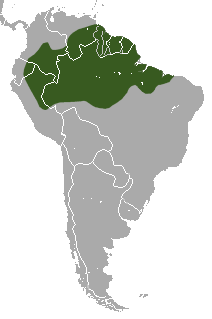
They are found in the Wild of Venezuela, Guyanas, Colombia, Ecuador, Peru and Brazil north of the Amazon River. Recently, there are evidence that suggests that this species's range expands into Bolivia.

Linné's Two-toed Sloth area.png

 Behavior

 It is a solitary, nocturnal and arboreal animal, found in rainforest. It is able to swim, making if possible to cross rivers and creeks. They live in ever-wet tropical rainforests that are hot humid. They tend to live in areas where there is a lot of vine growth so they can easily travel from tree to tree in the canopies of the forests. They mainly eat leaves, but there is lacking data on the extent of their diet due to their nocturnal lifestyle and camouflage. 

Predator

The two-toed sloth falls prey to wild cats such as the ocelot and jaguar as well as large birds of prey such as the harpy and crested eagles. Predation mainly occurs when the sloth descends to the ground in order to defecate or change trees. Anacondas have been known to hunt sloths.


Life Cycle

Linnaeus's two toed sloth has a ten-month gestation period. Their inter-birth rate extends past sixteen months so there is not an overlap pf young to care for. There is only one offspring per litter and the young becomes independent at about a year old. It take longer for two-toed sloths to become independent as well as the gestation period is longer than in three-toed sloths, It has been suggested that this difference may be caused by their difference in diet.

Tuesday, 5 April 2016

Hoffmann's Two-Toed Sloth


Kingdom: Animalia
Phylum: Chordata
Class: Mammalia
Order: Pilosa
Genus: Choloepus
Species: C. hoffmanni
Conservation Status: LC (Least Concerned)

Hoffmann's tow-toed nocturnal and arboreal animal, found in mature and secondary rainforests and deciduous forests. The common name commemorates the German naturalist Karl Hoffmann.

Description

This sloth is a heavily built animal with shaggy fur and slow, deliberate movements. The fore feet have only two toes, each ending with long, curved claws, The three toes sloth also have these same characteristics which may be found in the same geographic areas, but there are some characteristics that definitely distinguished them from the two toed sloths. Those characteristics include they have the longer snout, separate rather than partially fused toes of the forefeet, the absence of hair on the soles of the feet, and larger overall size. The wrist of the sloth has developed some specific traits due to their slow, yet acrobatic motions. These evolved traits include diminution and distal migration of the pisiform bone. with a loss of contact with the ulna; reduction of the distal end of the ulna to a styloid process, and extremely reduced contact between the ulna and triquetral bone.
This Hoffmann's two-toed sloth is very much related with Linnaeus's two-toed sloth. These two are also very closely resembles. The primary physical differences between the two species relate to suitable skeletal features.
Adults range from 54 to 72 cm in head-body length and weigh from 2.1 to 9 kg. Although they do not have stubby tails, just 1.5 to 3 cm long, this is too short to be visible through the long fur. The claws are 5 to 6.5 cm long. Females are larger on average than males, although with considerable overlap in size. Their fur is tan to light brown in colour, being lighter on the face, but usually has a greenish tinge because of the presence of algae living in the hairs.

Habitat

this sloth inhabits tropical forests from sea level to to 3300 m above sea level. It is found in the rainforest canopy in two separate regions of Central and South America, separated by the Andes. One population is found from eastern Honduras in the north to western Ecuador in the south and the other in eastern Peru, Western Brazil and northern Bolivia. According to the study a divergence date of about 7 million years between these populations has been suggested.

 Hoffmann's Two-toed Sloth area.png

Behavior

Two-toed sloth spend most of their time in trees, through they may travel on the ground to move to a new tree. A new study suggests on Barro Colorado Island, these species of sloth is exclusively nocturnal, even though in other locations they are known to be active during day. This is may be because of the competition with brown-throated sloth. They often move slowly through the canopy for about eight hours each night, and spend much of the day sleeping in tangles of lianas, They move only very slowly, typically at around 0.14 m/s, although they can move up to 50% faster when excited. They are solitary in the wild and aside from mothers with young, it is unusual for two be found in a tree at the same time.
Sloths have very poor eyesight and hearing and rely almost entirely on their sense of touch and smell to find food. This sloth is often spits when the mouth opens.

Diet

Their main source of diet is tree leaves. Though they also eat fruits and flowers. Sloths have three chambered stomachs. A sloth may take up to a month to completely digest a meal and up to two-thirds of a sloth's weight may be the leaves in its digestive system.

Predators

Sloths have many predators, including the jaguars, ocelots, harpy eagles, margays and anacondas.. If threatened, sloth s can defend themselves by slashing out at a predator with their huge claws or biting with their sharp cheek teeth. However, a sloth's main defense is to avoid being in the first place. The two-toed sloth can survive wounds that would be fatal to another mammal its size. The sloth's slow, deliberate movements and algae-covered fur make them difficult for predators to spot from a distance. Their treetop homes are also out of reach for many larger predators.

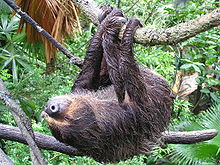
 Picture of two-toed sloth hanging from a branch
Life Cycle

Courtship consists of the female licking the male's face and rubbing her genitals against the male's body. Gestation lasts between 355 and 377 days, and results in the birth of a single young. The birth takes place in either the ground or in the hanging position. Newborn sloths weight 340 to 454 g. from birth they have long caws and able to cling to their mothers' undersides. The begin to take solid food at 15 to 27 days and are fully weaned by 9 weeks. young sloths make loud bleating alarm calls if separated from their mothers.
Hoffmann's sloth reach sexual maturity at two to four years of age and have been reported to live up to 32 years in captivity.

Conservation Status

Habitat destruction is probably causing a decrease in the wild Hoffmann's two-toed sloth population but little reliable data is available on the number of wild individuals. Sloths and people have little contact with one another in the wild.

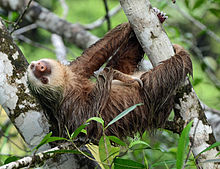
Choloepus hoffmanni (Puerto Viejo, CR) crop.jpg